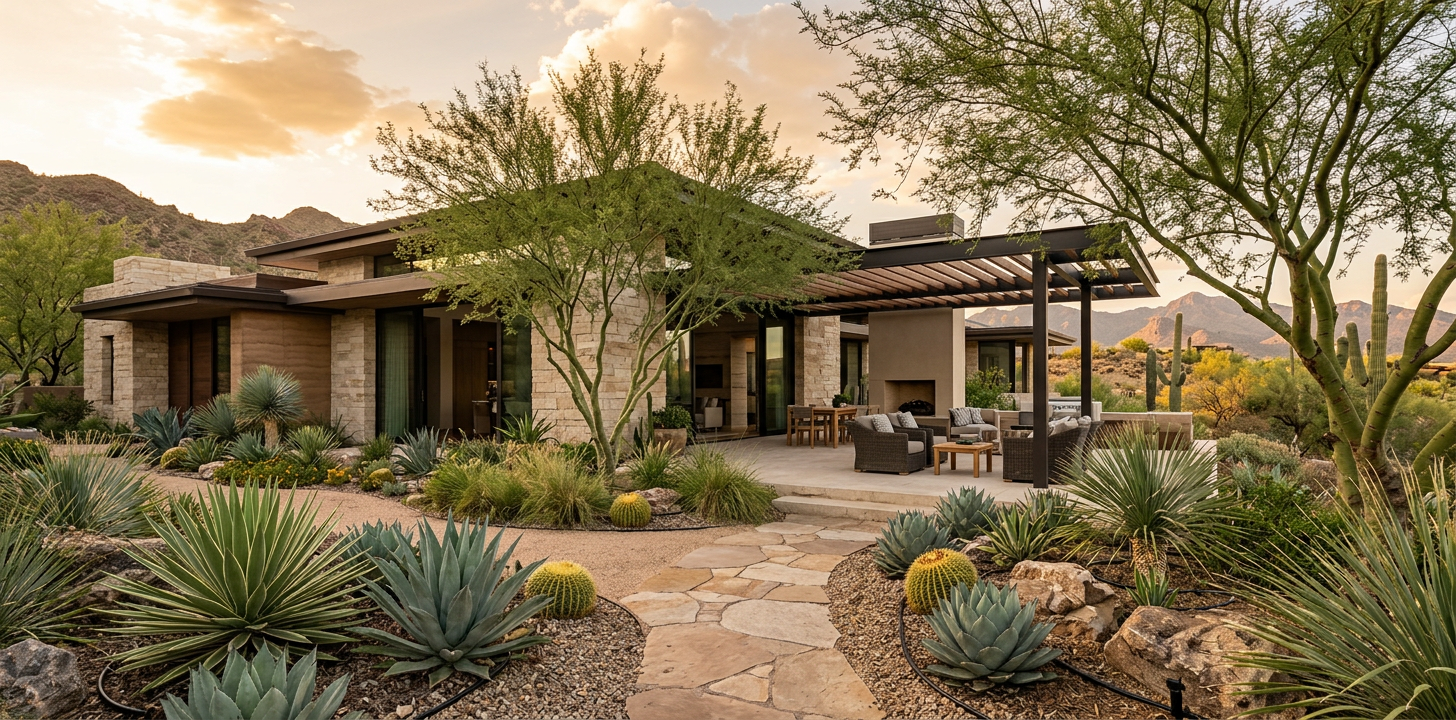
A beautiful Arizona landscape does not need to depend on excessive irrigation or a flat expanse of gravel. The strongest outdoor environments feel generous, lush in the right places, and deeply connected to the home’s architecture, while using water with intention.
For high-end homes in Scottsdale, Paradise Valley, Tempe, Phoenix, and the East Valley, water saving landscape solutions Arizona homeowners can rely on begin with a complete site strategy. Plant choices matter, but so do shade, soil, grading, irrigation zones, hardscape, mature trees, and how your family actually uses the property.
Water Saving Landscape Solutions Arizona for Luxury Properties
What A Water-Efficient Luxury Landscape Actually Includes
The goal is not to make every part of a property look the same. We design a hierarchy of spaces, with resilient low-water planting in broad landscape areas, concentrated planting near patios and entries, and shade where people gather. That approach supports both comfort and visual richness without treating every square foot as if it has identical water needs.
The Arizona Department of Water Resources reports that landscaping is the largest use of potable water in Arizona and that outdoor use can account for as much as 70 percent of residential water use. For a large custom property, that makes irrigation planning a design decision, not merely an installation detail.
| Design element | Water-saving role | Luxury benefit | Planning priority |
|---|---|---|---|
| Hydrozone planting | Matches water to plant needs | Fuller, healthier planting | High |
| Drip irrigation | Delivers water at the root zone | Cleaner visual finish | High |
| Shade trees and structures | Lowers heat stress | More usable outdoor rooms | High |
| Rainwater harvesting | Directs rainfall to planting | Site-specific character | Medium |
| Permeable surfaces | Helps water enter soil | Softer, tailored hardscape | Medium |
Start With The Site, Not A Plant List
A thoughtful plan studies orientation, grades, drainage patterns, existing vegetation, views, and outdoor living goals before plants are selected. This is especially important for hillside homes, large lots, and remodels where established trees may be among the property’s most valuable landscape assets.
We also look at where the home creates intense reflected heat, where winter sun is desirable, and where guests naturally move through the landscape. A courtyard, pool terrace, arrival sequence, or outdoor kitchen can feel cooler and more inviting when planting and shade are positioned deliberately.
Group Plants By Their Real Water Needs
Hydrozoning means placing plants with comparable water requirements on the same irrigation valve. It prevents a low-water desert accent plant from receiving the same schedule as a shaded flowering shrub or a specimen tree. It is simple in concept, but it requires coordination between planting design and irrigation documentation.
Desert-adapted does not mean every plant needs no water. New plantings need establishment care, mature shade trees need appropriate support, and seasonal weather changes affect demand. The practical goal is to give each plant the right amount of water at the right time, rather than using a single schedule across the entire property.
Five Design Strategies That Protect Water And Property Value
Preserve Mature Trees Whenever Possible
A mature mesquite, palo verde, olive, or other established tree can create meaningful shade that would take years to replace. Preserving suitable trees can reduce heat around hardscape, improve outdoor comfort, and anchor a new landscape so it feels established rather than recently installed.
Tree preservation must begin before demolition, grading, utility work, or new pool construction. Root-zone protection, proper drainage, and construction access planning are often more important than the final planting palette.
Build Shade Into Outdoor Living Areas
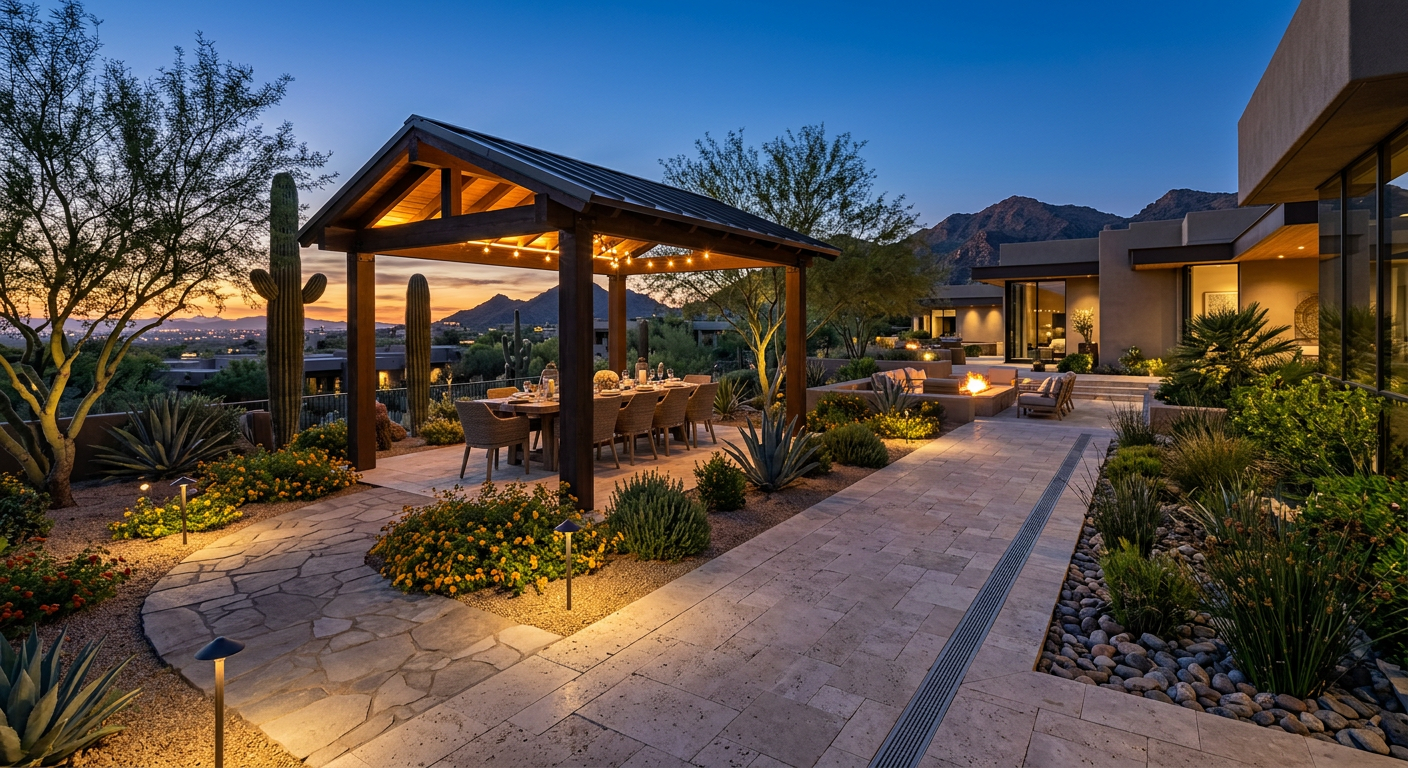
Arizona homeowners often focus on the pool or the outdoor kitchen first. We encourage clients to consider shade first as well. Trees, ramadas, pergolas, covered patios, and carefully placed walls can reduce the pressure placed on plants and make the landscape genuinely usable through more of the year.
Shade also gives us more flexibility with plant material. A protected courtyard can support a layered composition with small trees, shrubs, and accent planting that would struggle in exposed reflected heat.
Use Drip Irrigation As A Designed System
Drip irrigation is most effective when it is designed around plant sizes, root zones, slope, soil conditions, and separate hydrozones. It should not be an afterthought added after hardscape and planting decisions have already been made.
The state’s Guidelines for Landscape Drip Irrigation Systems emphasize design, installation, maintenance, operation, and repair. That full lifecycle matters. Even an excellent system wastes water if emitters are clogged, lines are damaged, or the controller never changes with the seasons.
Shape The Land To Hold Rainfall
Rainwater harvesting can be elegant and nearly invisible. Graded basins, swales, recessed planting areas, and strategically directed roof runoff can slow rainfall and guide it into the landscape rather than sending it off site.
The Arizona Department of Water Resources notes that rainwater harvesting reduces drinking-water use for irrigation and works especially well with native, low-water-use, and desert-adapted plants. On a custom residence, these features can be integrated into the overall geometry of the site instead of looking like a separate conservation add-on.
Improve Soil Before You Expect Plants To Perform
Compacted or poorly prepared soil can cause runoff, weak root development, and uneven irrigation performance. In many renovation projects, thoughtful soil preparation is what allows the planting to establish more evenly and use applied water more effectively.
Soil improvement is not one formula for every property. It depends on existing site conditions, selected plants, drainage, and construction disturbance. This is one reason a coordinated landscape architecture plan creates better long-term results than piecing together decisions as construction progresses.
A Better Alternative To The “Gravel And A Few Cactus” Approach
Water conservation does not require a stripped-down landscape. In fact, a property that relies only on rock can create more reflected heat, limit outdoor comfort, and feel disconnected from a home designed for entertaining.
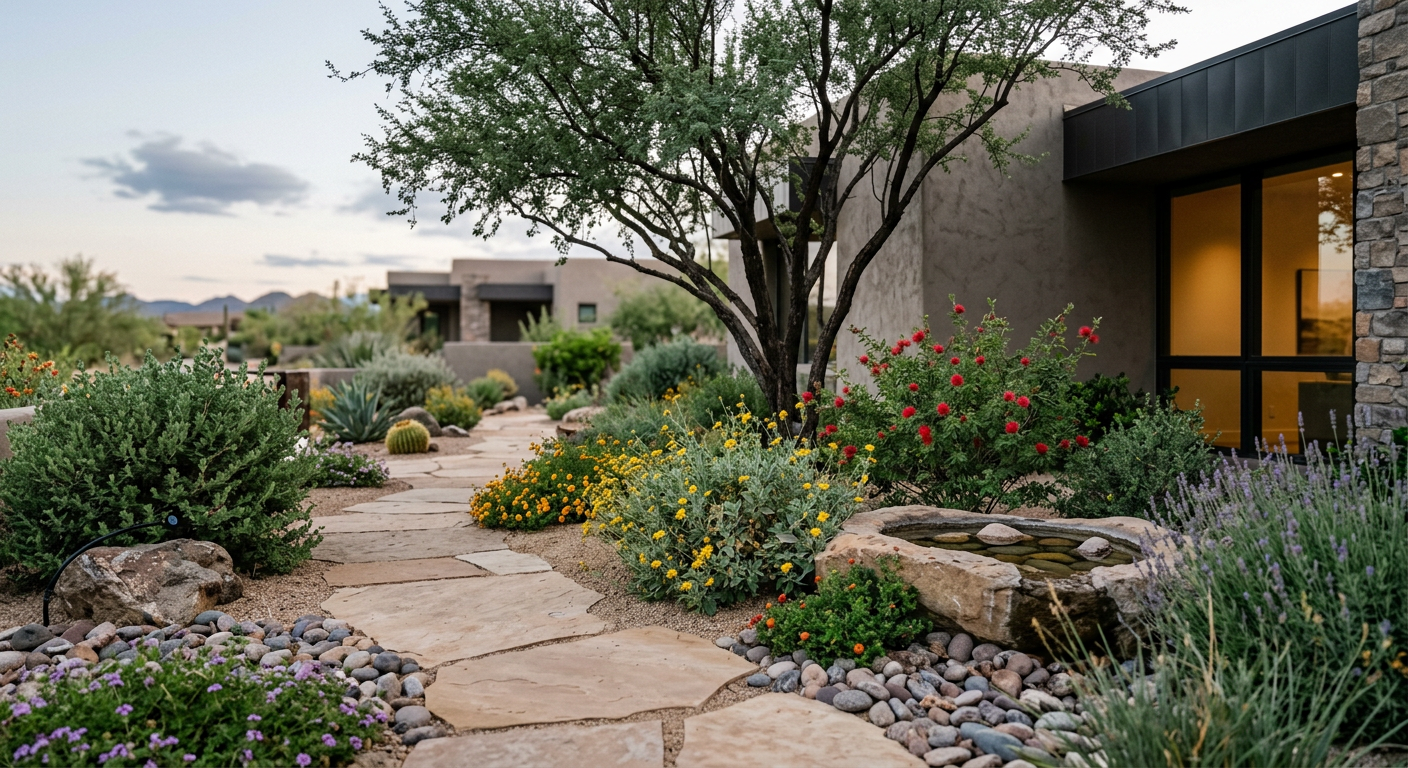
A high-performing desert landscape uses contrast and layers: shade trees, flowering shrubs, architectural succulents, native or climate-appropriate accents, groundcovers, boulders, and carefully proportioned paving. The result can feel serene and tailored while remaining far more responsible than a traditional high-water lawn.
The key is to place higher-water planting where it delivers the greatest experience, such as an arrival courtyard, a primary view, or the edge of a shaded terrace. More resilient planting can then carry the larger areas of the site with texture, seasonal interest, and lower irrigation demand.
Planning A Custom Landscape Project?
If you are building or remodeling a home in Tempe, Scottsdale, Paradise Valley, Phoenix, Carefree, Cave Creek, or the East Valley, early landscape planning can protect mature trees, coordinate utilities, and prevent costly revisions after hardscape is underway. Explore our residential landscape architecture approach and landscape architecture services to see how a complete plan brings site planning, planting, irrigation, and outdoor living together.
Call (480) 893-3849 to discuss a custom residential landscape project with Waibel & Associates.
Why Professional Coordination Matters
A landscape plan is a communication tool for the entire project team. It helps the architect, builder, pool consultant, lighting professional, and installer understand the intended relationships between grades, walls, paving, planting, irrigation, drainage, and utilities.
This coordination is especially valuable on luxury renovations, where the property may have mature vegetation, limited access, existing structures, or difficult grades. It is also valuable for HOAs and developers that need an appealing, durable landscape identity without avoidable water demand.
Janet Waibel, RLA, Owner and Principal of Waibel & Associates Landscape Architecture, brings landscape architecture, irrigation planning, site analysis, and construction administration into a connected process. For homeowners and project teams who want deeper educational context around sustainable landscape decisions, you can also explore landscape architecture books by Janet Waibel.
Frequently Asked Questions
Can a luxury Arizona landscape be water-efficient?
Yes. A luxury landscape can use shade, layered planting, stone, artful grading, outdoor living features, and carefully controlled irrigation to create a rich experience with substantially more intentional water use. Luxury comes from design quality and site-specific detail, not from irrigating every area equally.
What plants use the least water in the Phoenix area?
Plant selection should reflect the property’s sun exposure, soil, microclimates, and desired character. The Phoenix Active Management Area plant resources from the Arizona Department of Water Resources are a useful reference, but a professional plan should evaluate how each plant will perform in its specific location.
Is drip irrigation always better than spray irrigation?
Drip irrigation is often well suited to trees, shrubs, and many desert plantings because it applies water close to the root zone. However, the right approach depends on the planting type, soil, slope, and intended use, and every system needs seasonal monitoring and maintenance.
Should we remove all turf from a high-end property?
Not necessarily. Limited turf may be appropriate for a functional recreation area, a pet space, or a specific design purpose. The important question is whether it earns its place, receives the right irrigation, and is proportioned realistically within the overall water budget.
Can rainwater harvesting work on a custom home site?
Yes. Roof runoff, paved areas, and site grading can be planned to support planted basins, specimen trees, or other landscape areas. It works best when it is considered early, alongside architecture, drainage, and hardscape decisions.
When should we hire a landscape architect for a new home or major remodel?
Bring in a landscape architect during early architectural planning, before site work, pool layouts, utility routing, and grading are fixed. This creates more opportunity to preserve trees, protect views, coordinate outdoor rooms, and integrate water-efficient systems without expensive changes later.
The Long-Term Value Of Intentional Water Use
The best water-saving landscape is not a collection of isolated products. It is a cohesive outdoor environment that respects the Arizona climate, makes the home more enjoyable, and allows every plant, paved area, and irrigation zone to serve a purpose.
When we plan the site as one connected system, water efficiency supports beauty instead of competing with it. That is the difference between a landscape that simply survives the desert and one that feels completely at home in it.
Talk With An Experienced Arizona Landscape Architect
Whether you are planning a custom home, a major residential remodel, an outdoor living environment, an irrigation upgrade, or a sustainable landscape renovation, Waibel & Associates can help create a landscape that complements your architecture and long-term goals. Request a landscape architecture consultation → or call (480) 893-3849.
About Waibel & Associates Landscape Architecture
Waibel & Associates Landscape Architecture is an Arizona landscape architecture firm led by Janet Waibel, RLA, Owner and Principal. The firm provides custom residential landscape architecture, sustainable landscape design, irrigation planning, tree preservation, outdoor living design, site planning, construction documentation, and professional landscape consulting throughout Tempe, Scottsdale, Paradise Valley, Phoenix, North Scottsdale, Carefree, Cave Creek, and surrounding Arizona communities.
Waibel & Associates focuses on thoughtful, high-quality landscapes that complement the architecture of each property while incorporating appropriate plant materials, water-efficient strategies, irrigation technology, and long-term planning.
Janet Waibel is also a published author whose books provide educational resources on sustainable landscape management and landscape construction.
Planning a custom residential or professional landscape project?
Call (480) 893-3849 or contact Waibel & Associates →