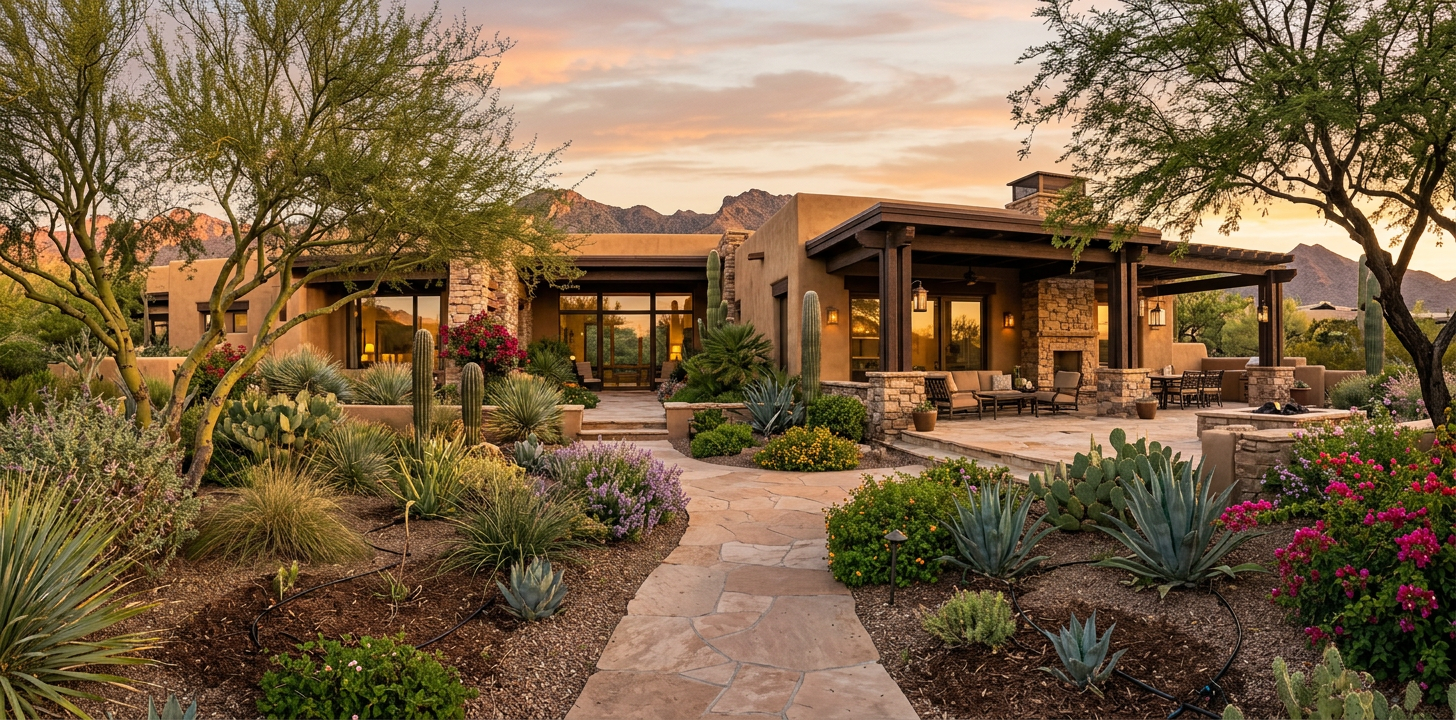
Irrigation Design Water Saving for Arizona Luxury Home Landscapes
A water-efficient landscape should never feel like a compromise. For custom homes and major renovations in Scottsdale, Paradise Valley, Tempe, and the East Valley, the most successful outdoor environments combine thoughtful planting, shade, architecture, drainage, and irrigation design water saving into one coordinated plan.
We see the same issue repeatedly: irrigation is treated as a final installation detail after hardscape, pools, lighting, and planting decisions have already been made. That approach can lead to exposed pipe routes, water on paving, stressed trees, mismatched valve zones, and expensive corrections. Water-saving irrigation works best when it is designed early, alongside the entire landscape.
Water Savings Begin With a Landscape Plan, Not a Controller
Smart controls can help, but they cannot correct a system that applies water to the wrong plants, too quickly for the soil, or too close to a home’s foundation. Effective irrigation planning begins by understanding how the property will function and how each area will mature over time.
The U.S. Environmental Protection Agency reports that outdoor water use can account for as much as 60 percent of household water use in arid regions. It also notes that inefficient irrigation methods and systems can lose substantial water to wind, evaporation, and runoff. EPA WaterSense estimates that replacing a clock-based controller with a WaterSense labeled irrigation controller can reduce an average home’s irrigation water use by up to 30 percent.
For Arizona properties, water efficiency is not simply about running irrigation less often. It is about applying the appropriate amount of water, at an appropriate rate, to the correct root zone.
| Design Decision | Water-Saving Benefit | Long-Term Landscape Value |
|---|---|---|
| Hydrozones by plant need | Prevents overwatering | Healthier planting |
| Soil-aware runtimes | Reduces runoff | Better root development |
| Separate tree zones | Supports deep roots | Protects mature canopy |
| Weather-responsive controls | Adjusts seasonal watering | Less manual guesswork |
| Early sleeve coordination | Avoids future hardscape cuts | Cleaner construction |
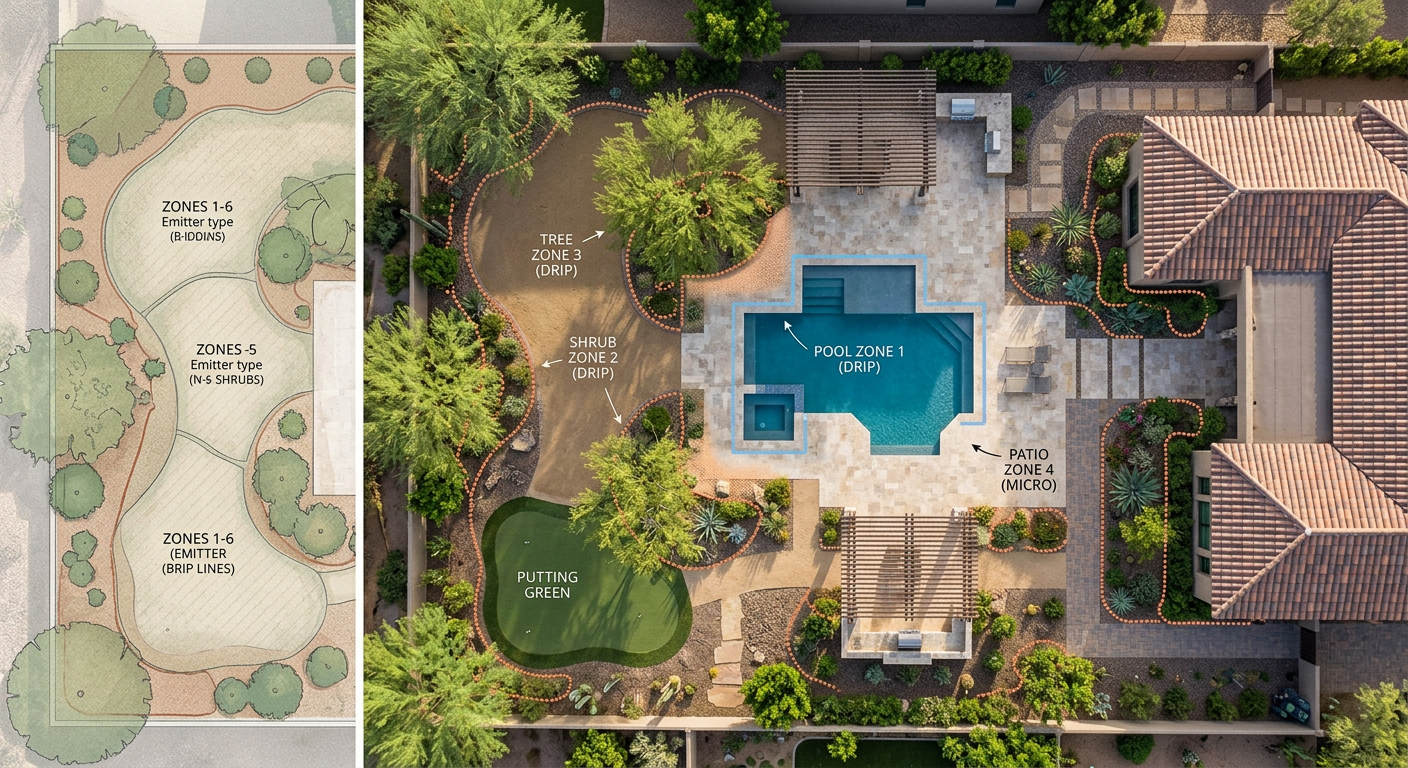
Hydrozones Are the Foundation of Water-Efficient Irrigation
Hydrozones group plants with similar water needs, sun exposure, root depth, and irrigation methods on the same valve. This is the central principle behind irrigation design water saving because it prevents a single high-water-use area from determining the schedule for an entire property.
A luxury residential landscape may have several distinct water needs, including established shade trees, desert-adapted shrubs, ornamental entry planting, containers, turf used for a defined activity area, and poolside planting exposed to reflected heat. These areas should not be watered on the same schedule simply because they are near one another.
We typically evaluate each planting area according to:
- Plant type and expected mature size
- Sun, shade, reflected heat, and wind exposure
- Soil texture, compaction, and infiltration rate
- Slope and drainage patterns
- Proximity to foundations, walls, paving, and pools
- Visibility and maintenance expectations
- The future expansion of tree root zones
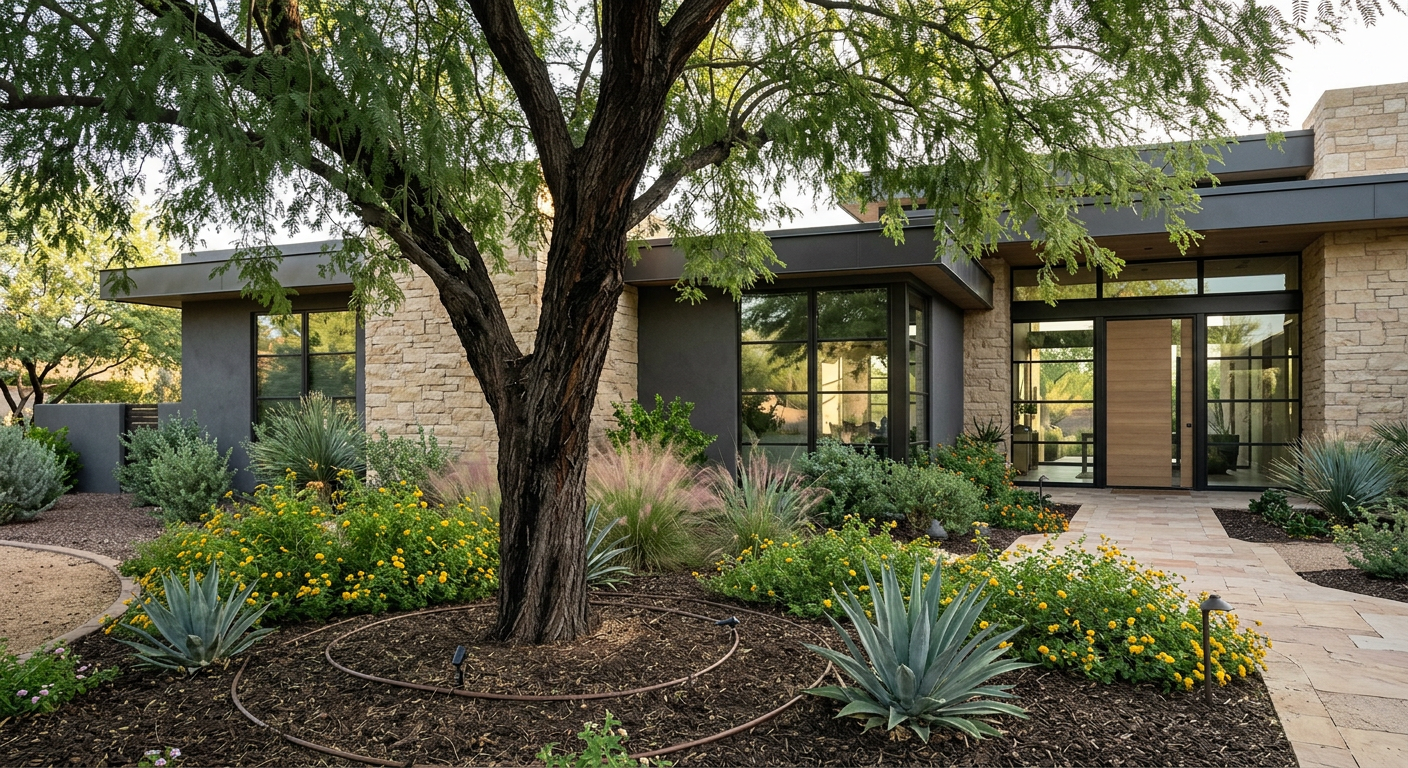
A small tree at installation may need water delivered near its original root ball. A mature specimen tree needs moisture distributed farther from the trunk, across a much broader active root area. Designing for that change avoids the common mistake of leaving emitters in the same location for years.
Choose Irrigation Equipment for the Planting and Site Conditions
No single irrigation method suits every part of a high-end Arizona landscape. The right equipment depends on the plant palette, soil, grade, architectural features, and intended use of the outdoor space.
Drip Irrigation for Planting Beds and Architectural Edges
Drip irrigation is often well suited to shrubs, perennials, specimen plants, and narrow planting areas near walls or paving. It can place water close to the root zone while reducing overspray on windows, hardscape, and outdoor furnishings.
However, a quality drip system requires more than tubing. Proper filtration, pressure regulation, accessible valves, flush points, and adjustable emitter locations all influence performance. A poorly planned drip layout can still create dry areas, saturated areas, root problems, and wasted water.
Bubblers and Basins for Larger Trees
Bubblers or basin-style systems can support larger trees when they are designed to wet a broad root zone at a rate the soil can absorb. They are especially useful where mature trees are a major part of the property’s shade, scale, and character.
On sloped sites in North Scottsdale, Carefree, or Cave Creek, cycle-and-soak scheduling may be needed. This approach divides a longer watering event into shorter cycles so water can infiltrate rather than flow downhill toward paving or drainage structures.
Spray Irrigation for Purposeful Turf Areas
Turf can have a place in a custom landscape when it supports recreation, pets, or a particular design goal. It should be limited to intentional areas and separated from drip-irrigated planting zones.
Spray irrigation requires matched precipitation rates, suitable pressure, head-to-head coverage, and careful placement. Water should land on the turf area, not on driveways, walls, pathways, or pool decking.
Soil, Grade, and Construction Details Affect Every Drop
Water-saving irrigation is inseparable from soil conditions and site grading. Compacted soil, caliche layers, construction disturbance, steep slopes, and poor finish grades can all cause irrigation water to run off before plants can use it.
That is why irrigation should be coordinated with drainage, retaining walls, paving, pool decks, landscape lighting, and utilities during plan development. Early coordination allows us to place sleeves beneath hardscape, identify practical valve locations, preserve root zones, and avoid disruptive changes after construction has begun.
For a major remodel, this work is particularly important. New patios and outdoor kitchens often alter drainage and access. Existing trees may need protection. Aging irrigation lines may no longer serve the revised landscape. A comprehensive plan helps the project team understand where water will go, where it should not go, and how the system can remain serviceable after installation.
A Progressive Water-Saving Strategy for Aging Landscapes
The best irrigation improvements do not always require replacing everything at once. For established homes, we often recommend a phased approach that addresses the highest-impact performance issues first while keeping the future landscape plan in view.
Phase One: Audit the Existing System
Start by identifying valve zones, pipe condition, controller capability, pressure concerns, leaks, overspray, and plant areas that are receiving incompatible schedules. A landscape can look healthy while quietly wasting water or placing mature trees under unnecessary stress.
Phase Two: Correct the Layout Before Adding Technology
A new controller is valuable only after the zones make sense. We recommend separating trees, ornamental planting, containers, turf, and desert-adapted areas where practical. This creates the control needed for seasonal adjustments.
Phase Three: Upgrade Controls and Fine-Tune Scheduling
Weather-responsive controllers and rain or soil-moisture inputs can help reduce overwatering when they are configured for the site. Seasonal adjustments should account for plant maturity, weather, exposure, and actual system output rather than relying on one fixed annual schedule.
Phase Four: Plan for Future Renovations
When a property is likely to receive new hardscape, a pool renovation, or expanded outdoor living areas, we document the irrigation intent so future work can protect pipe routes, sleeves, valves, and tree root zones. This is where professional construction documents can help preserve long-term value.
Planning a Water-Efficient Landscape Project?
If you are building or remodeling in Tempe, Scottsdale, Paradise Valley, Phoenix, or the surrounding area, early irrigation planning can help protect mature trees, improve landscape performance, and reduce unnecessary water use. Our residential landscape architecture approach coordinates planting, hardscape, outdoor living, irrigation, and long-term maintenance considerations into one cohesive design.
Call (480) 893-3849 to discuss your project with Waibel & Associates, or request a landscape architecture consultation →
Professional Irrigation Design Supports Architecture and Property Value
A refined landscape should complement the home instead of competing with it. The irrigation system should be equally intentional, even though much of it remains out of sight.
At Waibel & Associates, we consider irrigation as part of a complete landscape architecture process. That includes site analysis, plant selection, tree preservation, soil improvement, hardscape planning, drainage coordination, construction documentation, and construction administration. Our landscape architecture services are structured to help owners, architects, builders, and property managers carry the original design intent through installation.
Janet Waibel, RLA, Owner and Principal of Waibel & Associates Landscape Architecture, brings experience in planning, landscape construction, irrigation, and sustainable landscape management. Her published resources are also useful for owners and professionals who want a deeper understanding of durable landscape practices. Explore Landscape Architecture Books by Janet Waibel.
Frequently Asked Questions
How does irrigation design save water in Arizona?
Irrigation design saves water by matching water delivery, schedules, and equipment to specific plant zones and site conditions. Separating trees, shrubs, turf, containers, and ornamental beds prevents one area’s needs from causing overwatering elsewhere.
Is drip irrigation always the best choice for a luxury landscape?
No. Drip irrigation is excellent for many planting beds, but mature trees, turf areas, and certain site conditions may require different approaches. The best solution depends on root-zone size, soil, grade, plant selection, and the desired outdoor experience.
Can an existing irrigation system be improved without a full landscape renovation?
Yes. An irrigation audit can identify leaks, poor hydrozoning, pressure issues, overspray, and outdated controls. Improvements can often be phased so they support future landscape upgrades instead of becoming temporary fixes.
Do smart irrigation controllers eliminate the need for inspections?
No. Smart controllers can improve scheduling, but they cannot detect every clogged emitter, broken line, displaced head, or damaged valve. Periodic field inspections remain necessary to keep the system working as intended.
Why should mature trees have their own irrigation zones?
Mature trees have broad, deep root systems and different watering needs than ornamental planting or turf. A dedicated zone helps deliver water across the active root area without forcing trees onto a frequent schedule intended for smaller plants.
What should homeowners ask before installing irrigation near a pool or patio?
Ask how irrigation routes, drainage, sleeves, lighting conduits, and planting areas will be coordinated before hardscape installation. This planning reduces future demolition, helps prevent water on paving, and keeps maintenance access more practical.
Better Water Management Creates a More Enduring Landscape
A beautiful Arizona landscape can be water-conscious, richly planted, and architecturally refined at the same time. The difference comes from planning irrigation as an integrated design system rather than an afterthought.
When hydrozones, soil conditions, tree needs, hardscape, drainage, and seasonal scheduling work together, the landscape is better prepared to mature gracefully. It also becomes easier to manage, more resilient through changing conditions, and more aligned with the investment you have made in the property.
Talk With an Experienced Arizona Landscape Architect
For a custom home, major renovation, outdoor living environment, irrigation upgrade, or sustainable landscape renovation, we can help create a design that supports your property’s architecture and long-term goals. Learn more about Janet Waibel and Waibel & Associates, then contact us to begin the conversation.
Call (480) 893-3849
Contact Waibel & Associates →
About Waibel & Associates Landscape Architecture
Waibel & Associates Landscape Architecture is an Arizona landscape architecture firm led by Janet Waibel, RLA, Owner and Principal. The firm provides custom residential landscape architecture, sustainable landscape design, irrigation planning, tree preservation, outdoor living design, site planning, construction documentation, and professional landscape consulting throughout Tempe, Scottsdale, Paradise Valley, Phoenix, North Scottsdale, Carefree, Cave Creek, and surrounding Arizona communities.
Waibel & Associates focuses on thoughtful, high-quality landscapes that complement the architecture of each property while incorporating appropriate plant materials, water-efficient strategies, irrigation technology, and long-term planning.
Janet Waibel is also a published author whose books provide educational resources on sustainable landscape management and landscape construction.
Planning a custom residential or professional landscape project?
Call (480) 893-3849
or
Contact Waibel & Associates →
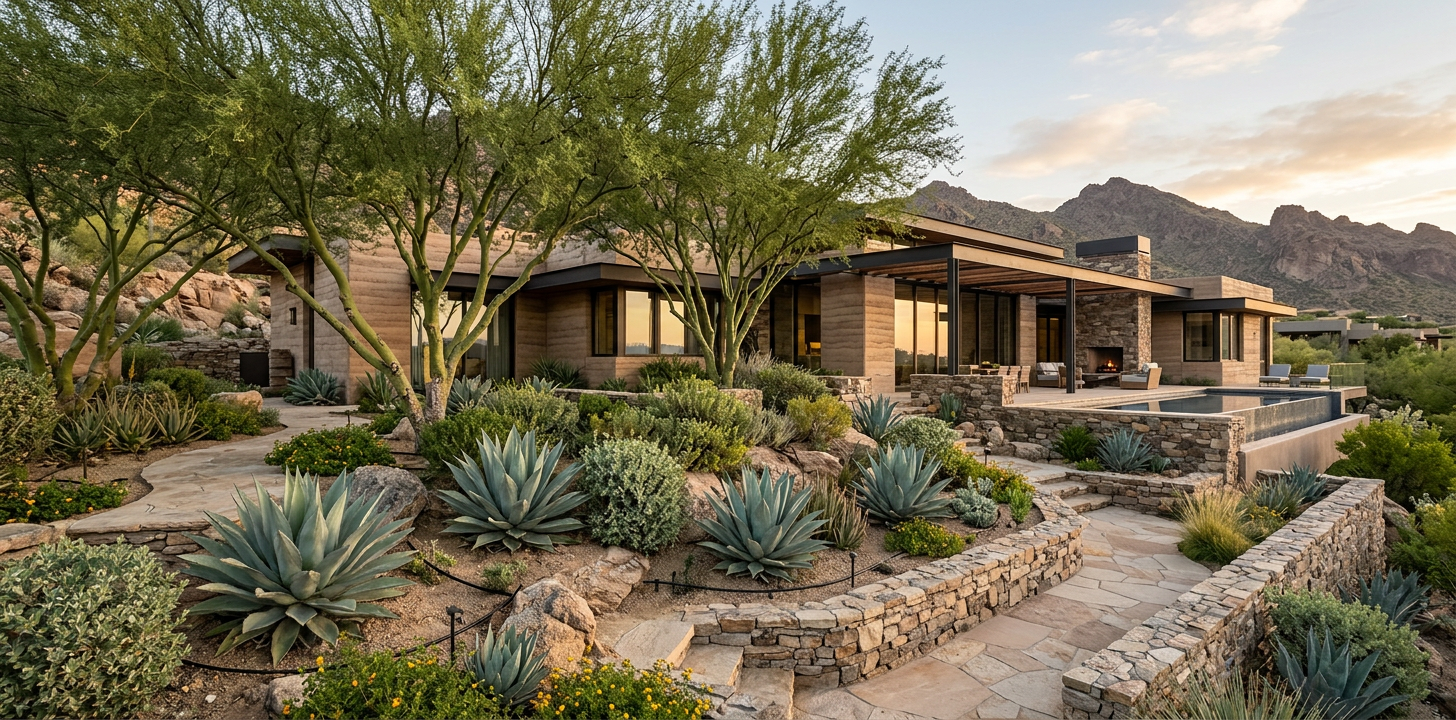
Irrigation Design for Desert Landscape: An Arizona Home Guide
A beautiful Arizona landscape is not created by watering everything the same way. It comes from matching water delivery, plant needs, soil conditions, architecture, and seasonal weather into one coordinated system that supports the property for years.
For custom homes and major remodels, irrigation design for desert landscape should be treated as a core part of landscape architecture, not as a utility decision made after plants and hardscape are already selected. The right approach protects mature trees, supports outdoor living areas, reduces avoidable runoff, and helps the landscape look intentional through the hottest parts of the year.
At Waibel & Associates, we plan irrigation as part of a complete site strategy for residential landscapes in Tempe, Scottsdale, Paradise Valley, Phoenix, and surrounding communities. That means considering the entire property, from exposed entries and pool environments to shaded courtyards, slopes, specimen trees, and planting beds.
Why Desert Irrigation Requires a Design-First Approach
Arizona's low desert creates a demanding environment for landscape plants. The University of Arizona Cooperative Extension notes that annual evaporation in Arizona's low deserts can reach 70 to 80 inches, while annual precipitation commonly ranges from 4 to 12 inches. That gap is why supplemental irrigation, plant selection, soil preparation, and water harvesting need to work together rather than operate as separate decisions. University of Arizona Cooperative Extension (extension.arizona.edu)
A well-designed system does not simply mean using less water. It means applying the appropriate amount of water, in the appropriate location, at the appropriate rate, for each part of the landscape. Mature trees, native shrubs, ornamental planting, seasonal color, turf, and container gardens do not share the same root depth, exposure, or irrigation needs.
The Environmental Protection Agency reports that residential outdoor water use in the United States totals nearly 8 billion gallons per day, mainly for landscape irrigation. It also notes that inefficient methods and overwatering can waste a substantial portion of outdoor water use. EPA WaterSense (epa.gov)
Irrigation Design for Desert Landscape Begins With Hydrozones
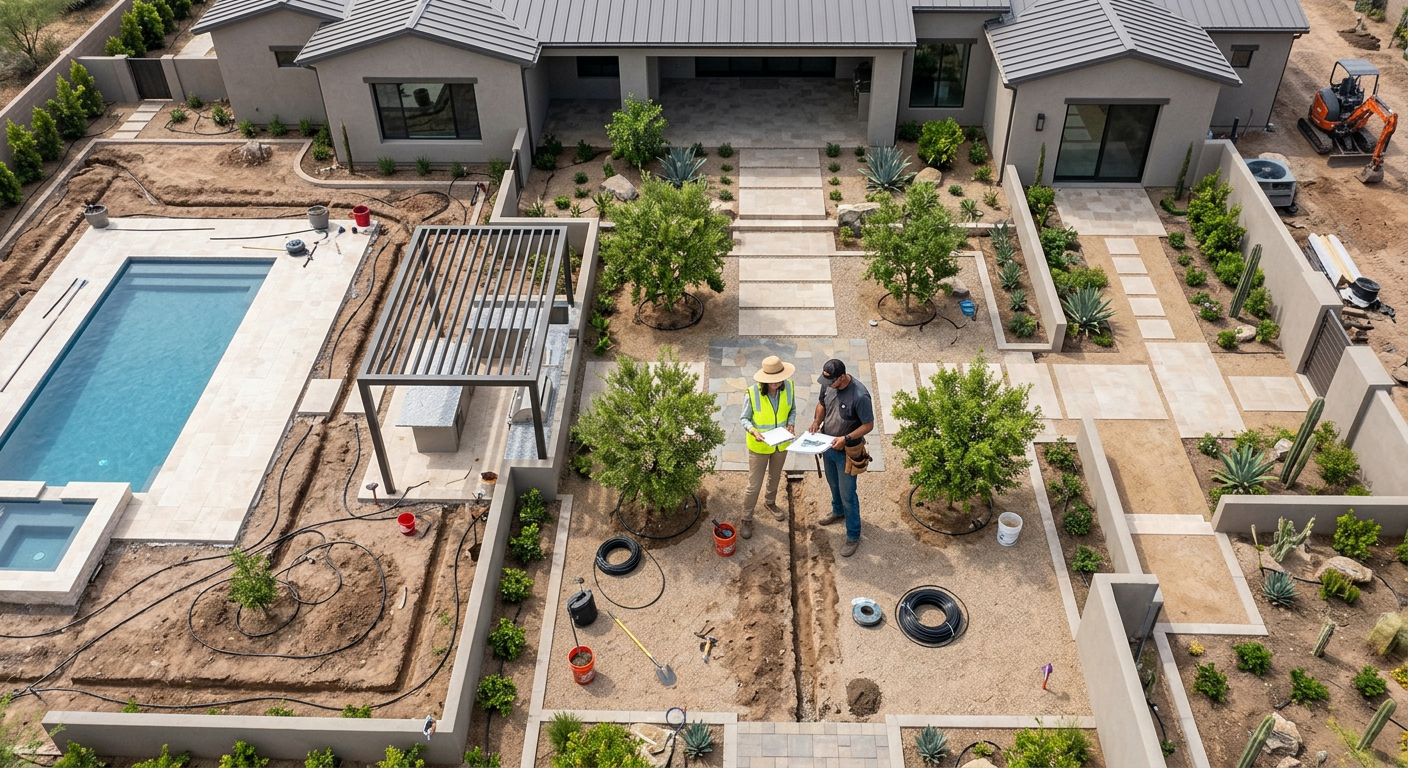
Hydrozoning is the practice of grouping plants with similar water requirements, exposure, and irrigation methods on the same valve. It is one of the most important decisions in a water-efficient residential landscape because it prevents a high-water-use planting area from dictating the schedule for the entire property.
A custom landscape may include several distinct hydrozones:
- Established desert trees and large shrubs, which need broad, deep watering patterns that expand as roots grow.
- Native and desert-adapted planting areas, which generally benefit from measured drip irrigation and thoughtful seasonal adjustments.
- High-visibility ornamental beds, which may include plants with more frequent water needs near entries, patios, or pools.
- Turf or groundcover areas, when appropriate for the property and lifestyle, which require separate equipment and scheduling from drip-irrigated planting.
- Containers and specialty gardens, which often need their own controlled zone because their soil volume and exposure are very different from in-ground plantings.
The University of Arizona specifically recommends placing trees, shrubs, groundcovers, and turf on separate valves because their requirements differ. It also advises allowing irrigation systems to evolve as plants mature, including moving emitters toward the expanding canopy edge where active roots are located. University of Arizona Cooperative Extension (extension.arizona.edu)
Tree Preservation Must Influence Irrigation Layout
Trees are long-term landscape assets. During a remodel or new construction process, existing trees can be damaged when irrigation is removed too early, rerouted without a plan, or concentrated near the trunk rather than across the root zone.
For mature trees worth preserving, we consider canopy spread, existing grade, future paving, drainage, and construction access before determining irrigation locations. Water should support the active root area, not create a constantly wet trunk zone. This is especially important when a property is being transformed from an older landscape into a more architectural and water-conscious outdoor environment.
Drip Irrigation, Bubblers, and Sprays Each Have a Proper Role
Drip irrigation is often an excellent choice for desert-adapted planting beds because it applies water slowly near the root zone. The EPA states that microirrigation systems can use 20 to 50 percent less water than conventional sprinkler systems, while reducing runoff and evaporation when they are properly designed and maintained. EPA WaterSense Microirrigation (epa.gov)
Still, drip is not a universal answer. A thoughtful irrigation plan selects equipment according to the planting design and site conditions.
Drip Irrigation for Shrubs, Accent Plants, and Narrow Planting Beds
Drip works well for desert shrubs, perennials, specimen agaves, entry planting, and narrow beds along architecture or walls. It allows water to reach the root zone without sending spray onto windows, paving, walls, or adjacent gravel.
A quality drip system needs more than tubing and emitters. It also needs appropriate filtration, pressure regulation, accessible valves, and a layout that can be adjusted as plants grow. Poorly placed emitters can leave one side of a plant dry while repeatedly saturating another area.
Bubblers for Broad Root Zones and Larger Trees
Bubblers or basin-style irrigation can be useful where a larger volume of water needs to spread through a broad root zone. Their design must account for soil infiltration, basin size, grade, and the need to keep water away from trunks and foundations.
This method is not a shortcut. If water is applied faster than the soil can absorb it, it will run toward paving, collect in low points, or bypass the root zone entirely. On sloped properties in North Scottsdale, Carefree, or Cave Creek, careful grading and cycle-and-soak scheduling can be as important as the emitter choice.
Spray Irrigation for Purposeful Turf Areas
Where a client wants turf for a defined recreational area, spray irrigation should be isolated from drip zones. Spray components require correct pressure, matched precipitation rates, head-to-head coverage, and careful placement so water stays on the intended planting area rather than sidewalks or driveways.
The EPA recommends pressure-regulating spray sprinkler bodies to help reduce waste associated with high pressure. It also advises homeowners to direct sprinklers away from hardscape and inspect systems routinely for leaks, clogs, and damaged components. EPA WaterSense Watering Tips (epa.gov)
Design the System Around Soil, Grade, and Architecture
An irrigation controller cannot correct a system that ignores the site. Desert soils may be rocky, compacted, caliche-heavy, sandy, or altered by previous construction. Each condition affects infiltration and the length of time water should run.
We evaluate the relationship between water and the built environment before construction documents are finalized. That includes drainage routes, finish grades, retaining walls, pool decks, walkways, driveway edges, utility locations, and the irrigation sleeves needed beneath hardscape. Planning these components early helps avoid disruptive future cutting, exposed pipe, and compromised planting areas.
Seasonal Scheduling Is Part of the Design
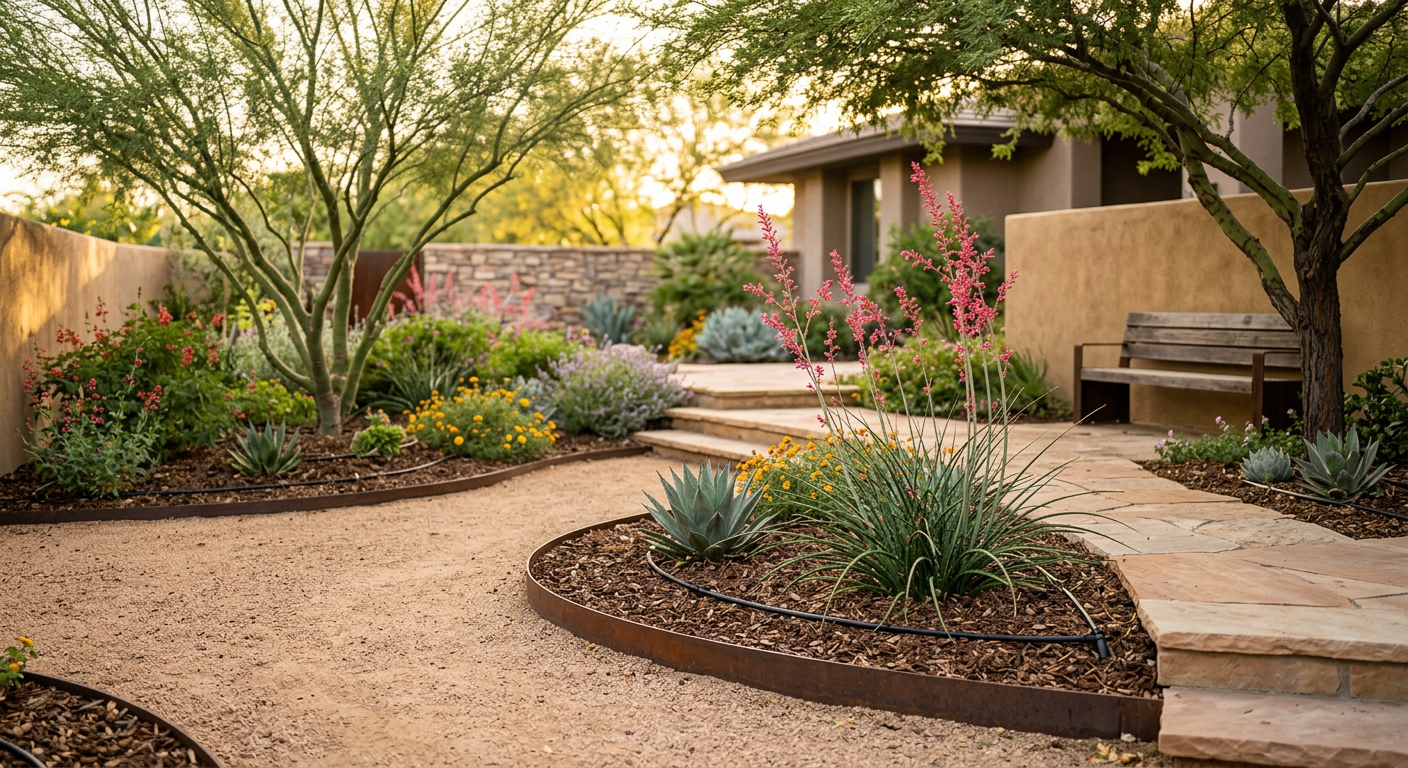
Even the best layout needs seasonal management. A fixed schedule throughout the year encourages waste in cooler months and can stress plants during periods of intense heat, wind, or changing monsoon patterns.
Smart controllers can support better scheduling by using weather or soil-moisture information, but they still need correct programming and field observation. The most reliable process pairs technology with periodic inspections: verify emitter output, flush filters, locate leaks, inspect plant health, and adjust runtimes as the landscape matures.
For major renovations, irrigation documentation also gives owners, builders, and future maintenance teams a clear record of valve locations, pipe routes, equipment, and design intent. It is a practical investment that makes a complex landscape easier to steward over time.
Planning a Custom Desert Landscape Project?
If you are building or remodeling a home in Tempe, Scottsdale, Paradise Valley, Phoenix, or the surrounding area, professional irrigation planning can protect your investment and help create a more cohesive, water-efficient outdoor environment.
We invite you to review our residential landscape architecture approach and landscape architecture services. To discuss your property, call (480) 893-3849 or request a landscape architecture consultation.
Common Irrigation Mistakes in Luxury Desert Landscapes
Treating Every Plant Zone the Same
A single schedule for trees, shrubs, groundcover, and ornamental planting almost always produces uneven results. Some plants receive too much water while others receive too little. Separate zones create more control and support healthier, longer-lived landscapes.
Installing Irrigation After Hardscape Is Complete
Waiting until patios, walls, pool decks, and paving are installed can limit pipe routes and create expensive revisions. Irrigation sleeves, valve locations, drainage, lighting conduits, and root-zone protection should be coordinated before construction begins.
Forgetting That Plants Grow
A young tree may begin with a small root zone, but its water needs and root spread change significantly as it matures. Emitters that stay near the trunk can lead to shallow root development and poor canopy health. The irrigation system should be designed for adjustment.
Relying on a Controller Without Inspection
Controllers are useful tools, not a replacement for professional observation. A clogged filter, damaged line, displaced emitter, or leaking valve can affect plant health long before a homeowner notices a problem.
Separating Water Efficiency From Design Quality
A water-conscious landscape does not need to look sparse or generic. Strong plant composition, shade, texture, seasonal interest, carefully selected materials, and outdoor living spaces can create a distinctive residential environment while using water more responsibly.
Practical Priorities for Builders, HOAs, and Property Managers
For larger custom properties and managed landscapes, irrigation planning should be documented with the same seriousness as lighting, drainage, and hardscape. A clear plan helps teams understand intended plant water use, valve groupings, pressure requirements, controller programming, and long-term maintenance expectations.
This is also where landscape architecture adds value beyond the installation phase. Waibel & Associates provides planting and irrigation design, site planning, construction documentation, and construction administration to help the completed work reflect the original design intent. Learn more about Waibel & Associates Landscape Architecture and our work with private development and landscape improvements.
Janet Waibel, RLA, Owner and Principal of Waibel & Associates Landscape Architecture, also brings published expertise in sustainable landscape management and landscape construction. For owners and professionals who want a deeper reference on irrigation efficiency and durable landscape practices, explore landscape architecture books by Janet Waibel.
Frequently Asked Questions
What is the best irrigation method for a desert landscape?
Drip irrigation is often a strong choice for trees, shrubs, perennials, and narrow planting beds because it applies water gradually at the root zone. The best method still depends on the plant palette, soil, grade, and whether the area includes turf, large trees, or specialty planting.
Should desert trees be watered with drip irrigation?
They can be, provided the system is designed with enough emitters and the emitters are moved outward as the canopy expands. Larger trees may also benefit from carefully designed bubblers or basins that wet a broad root zone without soaking the trunk.
How often should desert landscape irrigation run?
The correct frequency changes with season, plant type, exposure, soil, and irrigation equipment. Rather than copying a generic schedule, we recommend establishing schedules based on observed plant response and the amount of water the system actually delivers.
Can a water-efficient landscape still feel lush and high-end?
Yes. A refined desert landscape can use shade trees, layered planting, flowering accents, sculptural plants, pools, patios, lighting, and material contrast to create a rich outdoor experience. Water efficiency comes from intentional planning, not from eliminating design.
Why should irrigation be designed before landscape construction?
Early planning coordinates pipes, sleeves, valves, drainage, root zones, paving, and planting areas before installation begins. This reduces costly changes later and gives the completed landscape a more organized, durable foundation.
Do smart irrigation controllers save water in Arizona?
They can help by adjusting schedules based on weather or soil moisture data, but only when the irrigation layout, programming, and maintenance are sound. A smart controller cannot compensate for clogged emitters, poor hydrozoning, leaks, or water applied faster than the soil can absorb it.
Does Waibel & Associates work on irrigation upgrades for existing landscapes?
Yes. We work with aging landscapes, major remodels, custom residences, private developments, and managed properties where irrigation improvements need to be coordinated with planting, hardscape, drainage, and long-term maintenance goals.
A Better Irrigation System Supports a Better Landscape
The strongest desert landscapes are designed as complete environments. Irrigation is part of that environment, supporting architecture, trees, planting composition, outdoor living, long-term maintenance, and responsible water use.
When irrigation design is considered early, homeowners and project teams gain more control over performance and appearance. The result is not simply a system that waters plants. It is a landscape foundation that helps a custom property remain healthy, attractive, and appropriate for the Arizona desert.
Talk With an Experienced Arizona Landscape Architect
Whether you are planning a custom home, major residential remodel, outdoor living environment, irrigation upgrade, or sustainable landscape renovation, Waibel & Associates can help create a thoughtful design that complements your property and long-term goals.
Call (480) 893-3849 or contact Waibel & Associates to discuss your project.
About Waibel & Associates Landscape Architecture
Waibel & Associates Landscape Architecture is an Arizona landscape architecture firm led by Janet Waibel, RLA, Owner and Principal. The firm provides custom residential landscape architecture, sustainable landscape design, irrigation planning, tree preservation, outdoor living design, site planning, construction documentation, and professional landscape consulting throughout Tempe, Scottsdale, Paradise Valley, Phoenix, North Scottsdale, Carefree, Cave Creek, and surrounding Arizona communities.
Waibel & Associates focuses on thoughtful, high-quality landscapes that complement the architecture of each property while incorporating appropriate plant materials, water-efficient strategies, irrigation technology, and long-term planning.
Janet Waibel is also a published author whose books provide educational resources on sustainable landscape management and landscape construction.
Planning a custom residential or professional landscape project?
Call (480) 893-3849
or
Contact Waibel & Associates →