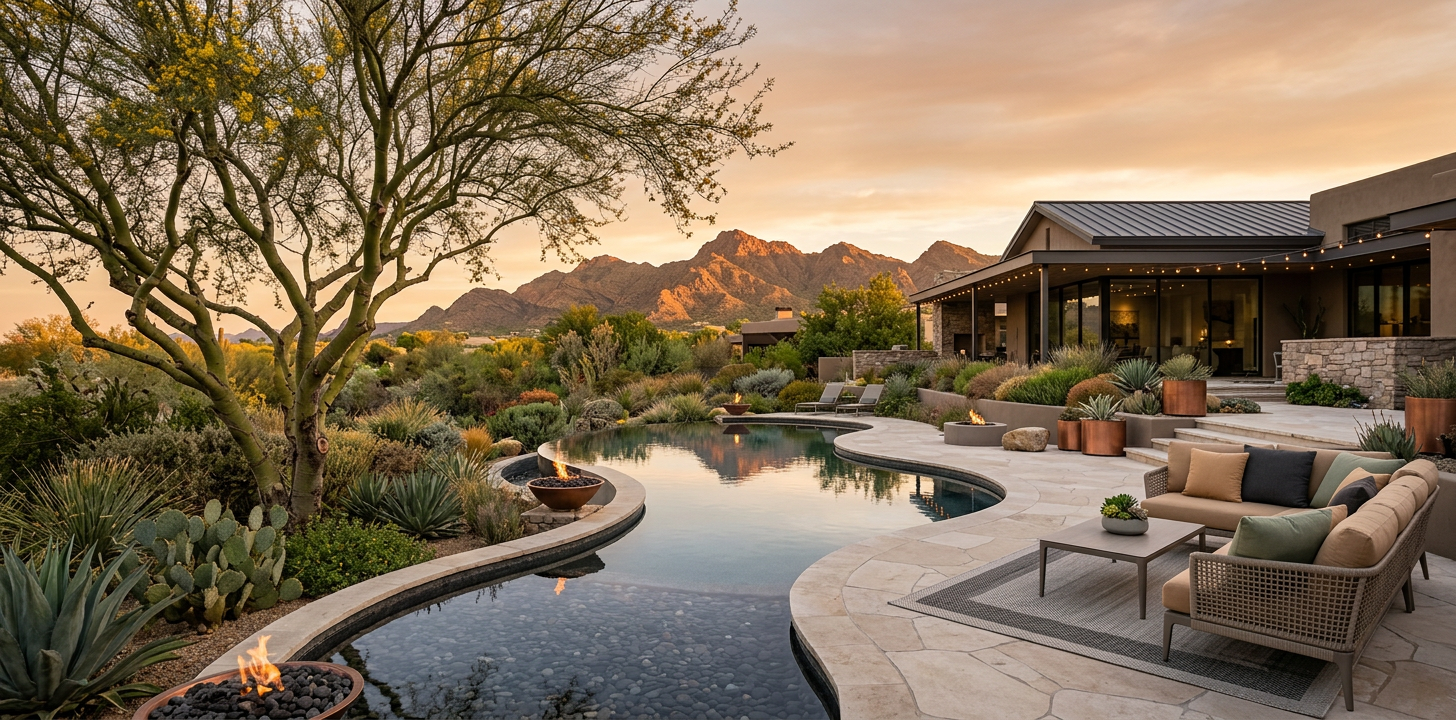
A beautiful desert property should feel effortless, but the best outdoor spaces are anything but accidental. From the first view from the street to the last evening conversation beside the pool, every material, plant, and pathway needs to work together with the home, the climate, and the way you actually live.
That is the standard we bring to luxury landscape design Scottsdale homeowners and project teams expect. Rather than adding isolated features, we shape complete outdoor environments that feel composed, comfortable, durable, and distinctly connected to their setting.
What Sets a Luxury Desert Landscape Apart
Luxury is not defined by the most expensive finish or the largest water feature. It comes from restraint, proportion, thoughtful details, and a clear relationship between architecture and site. The most successful properties make indoor and outdoor living feel like one continuous experience.
| Design priority | Generic yard plan | Luxury landscape approach |
|---|---|---|
| Layout | Features placed separately | Spaces planned as a sequence |
| Planting | Decorative, often repetitive | Layered for shade, texture, and season |
| Materials | Selected individually | Unified with the home's architecture |
| Water use | Added after design | Built into planting and irrigation strategy |
| Construction | Limited field coordination | Detailed plans and installation oversight |
A high-end landscape also has to perform in the Sonoran Desert. The Arizona Department of Water Resources notes that as much as 70 percent of residential water use can occur outdoors. That makes planting design, hydrozones, irrigation layout, and long-term maintenance choices central to both comfort and responsible ownership.
Start With the Architecture and the Site
Before choosing a single plant or paver, we look at what the property is already telling us. The home’s lines, elevations, window views, shade patterns, grades, existing trees, and surrounding context become the framework for every later decision.
Create a strong arrival experience
The front landscape establishes the tone before anyone reaches the door. A carefully scaled entry sequence might include a shaded walk, specimen trees, sculptural agaves, low-glare lighting, and a material transition that echoes the architecture.
For contemporary homes, we often use clean planting masses and strong geometry. For Mediterranean, transitional, or desert ranch architecture, a softer arrangement of textured planting, stone, and layered canopy can create an equally polished result without feeling overly formal.
Protect the views worth keeping
In Scottsdale, views can be as valuable as the home itself. That may mean framing Camelback Mountain, preserving a distant desert horizon, screening an adjacent property, or controlling views from interior rooms to a private courtyard.
A thoughtful plan considers eye level from patios, kitchens, bedrooms, and pool lounges. We also plan for how trees and shrubs will mature, because a beautiful opening can disappear quickly when fast-growing plants are installed without a long-range strategy.
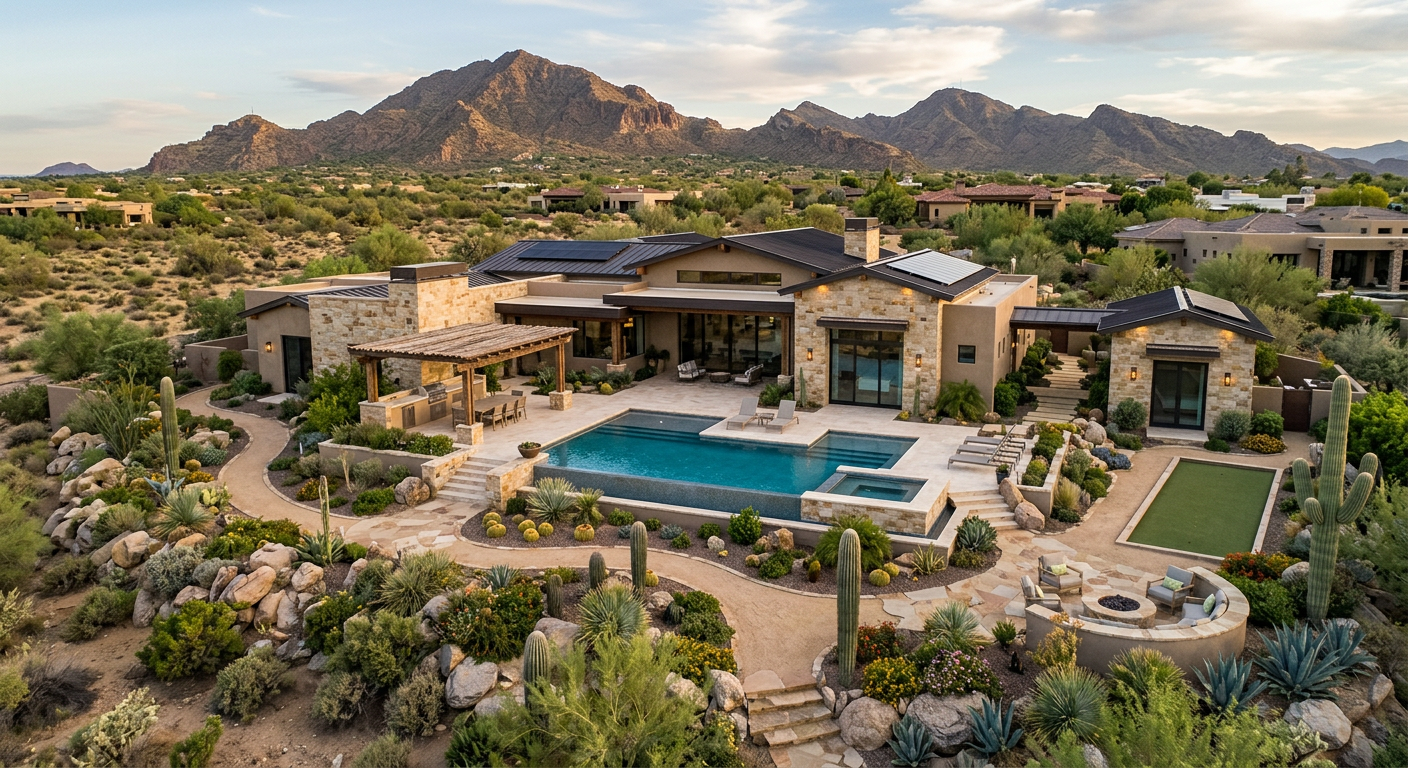
Design Outdoor Rooms That Invite You Outside
The best luxury backyards do more than look finished from a window. They create reasons to linger outdoors, whether that means a quiet morning coffee, a family dinner, or an evening gathering that flows naturally beyond the home.
Give each area a clear purpose
We begin by mapping how a household entertains, relaxes, cooks, swims, and moves through the property. A pool terrace, outdoor kitchen, fire feature, shaded dining area, and garden lounge can all belong in one backyard, but they should not compete for attention.
Clear circulation is what makes an elaborate plan feel easy. Paths should lead somewhere meaningful, seating should have an appealing view, and doors should open into spaces that feel immediately useful rather than unfinished.
Make shade a design feature
Summer comfort is fundamental in the Valley. Deep overhangs, ramadas, mature canopy trees, shade sails, covered patios, and well-oriented structures can turn a beautiful but underused yard into a true extension of the home.
We also consider late-afternoon sun, reflected heat from walls and paving, and the changing angle of light across the year. Shade needs to be planned at the same time as the pool, paving, planting, and furnishings, not patched in afterward.
Use lighting to reveal, not overwhelm
Good landscape lighting is subtle. It helps guests move safely, adds warmth to entertaining spaces, highlights carefully selected trees or art, and makes the garden feel dimensional after dark.
We favor layered lighting over a blanket of brightness. Path lights, low-level step illumination, discreet uplighting, and focused accents create atmosphere while preserving the quiet character of the night sky.
Build a Water-Wise Landscape Without Sacrificing Beauty
A water-efficient landscape should never feel like a compromise. In fact, desert-adapted planting often gives us richer texture, more interesting silhouettes, and a stronger connection to place than a lawn-heavy plan ever could.
Select plants for beauty and resilience
We use a layered palette that can include desert trees for canopy, flowering shrubs for seasonal color, grasses for movement, succulents for sculptural form, and groundcovers that soften hardscape edges. The goal is not to fill every inch of soil, but to compose plant communities with room to mature.
Plant selection should account for sun exposure, soil conditions, reflected heat, root behavior, mature size, and irrigation needs. The City of Scottsdale offers a desert landscape plant guide with more than 200 low-water-use plant options, a useful resource for homeowners who want a stronger regional palette.
Match irrigation zones to actual needs
Efficient irrigation begins with design. Trees, shrubs, succulents, turf, and containers should not be grouped on the same schedule simply because they happen to sit near one another.
We plan hydrozones around plant water requirements and use appropriate drip systems, emitters, valves, and controllers to support them. This approach reduces waste, simplifies ongoing care, and gives plants a far better chance of thriving through Scottsdale’s hottest months.
Add water harvesting where it makes sense
Rainfall may be limited, but it is still an asset when a site is designed to use it. Grading, swales, basin planting, permeable surfaces, and roof runoff strategies can guide water toward trees and planting areas instead of sending it away.
The state’s rainwater harvesting guidance explains that capturing rainfall can reduce demand for drinking water used in landscape irrigation. On a custom property, those details can be integrated elegantly into the design rather than looking like an add-on.
Choose Materials That Age Gracefully
Hardscape sets the visual and practical foundation for outdoor living. Stone, porcelain, concrete, metal, wood, and masonry all have a place, but each should be chosen for the home’s architectural language, exposure, maintenance expectations, and tactile experience underfoot.
We focus on a limited, intentional material palette. Repeating one stone from the front entry to the pool coping, retaining walls, or fireplace surround can make a large property feel composed, while subtle changes in texture help individual outdoor rooms feel distinct.
Heat is also a practical consideration. A surface that looks beautiful in a showroom may feel punishing in full sun, so we weigh color, finish, glare, slip resistance, and how a material will hold up through intense weather cycles.
Why Detailed Planning Protects the Investment
A luxury landscape is a major construction project, not a decorating exercise. Without clear drawings, specifications, finish selections, and site coordination, even an appealing concept can lose quality during installation.
Our residential landscape design process is built around comprehensive planning, from spatial concepts and planting to paving, irrigation, lighting, pools, outdoor living elements, and construction coordination. That level of documentation helps homeowners, architects, builders, and installers make decisions with greater clarity before changes become costly in the field.
For custom homes and major renovations, coordination should begin early. Pool equipment, drainage, utility locations, retaining walls, grade changes, tree preservation, and outdoor kitchen infrastructure all influence the final landscape, and each is much easier to resolve before construction is underway.
Questions Homeowners Often Ask
How much should we budget for a luxury landscape in Scottsdale?
Budgets vary widely based on lot size, grading, pool work, structures, hardscape, materials, mature specimen plants, lighting, and site constraints. We recommend establishing a realistic project range early so the design can prioritize the features that will have the greatest impact on daily enjoyment and long-term value.
Can we have a lush landscape without high water use?
Yes. Lushness comes from layering, shade, texture, seasonal interest, and careful composition, not from covering the site with turf. Desert trees, shrubs, flowering accents, grasses, and shade-oriented planting can create a rich visual experience with far more appropriate water use.
Should landscape design happen before or after pool design?
Ideally, the pool and landscape are planned together. The pool affects circulation, sightlines, equipment placement, drainage, shade, lighting, planting, and the overall balance of the backyard, so separate design decisions can create expensive conflicts later.
What plants work well around a Scottsdale pool?
We typically look for plants that tolerate heat and reflected light, fit the desired style, and do not create excessive litter or invasive root concerns. The exact palette depends on the pool’s exposure, nearby hardscape, irrigation system, and how much privacy or shade the space needs.
How long does a custom landscape project take?
The timeline depends on design complexity, permitting, procurement, contractor schedules, and construction scope. A complete plan allows the team to anticipate decisions and phase work intelligently, which helps create a smoother project even when the site is complex.
Will a desert landscape look bare in winter?
Not when it is designed with year-round structure in mind. Evergreen forms, branching silhouettes, ornamental grasses, stone, art, lighting, and winter bloomers can keep the property visually engaging throughout the year.
Plan an Outdoor Space That Belongs to Your Home
If you are building a custom home, renovating an established property, or rethinking a high-value outdoor space, we can help you shape a landscape with purpose from the beginning. Waibel & Associates provides site planning, custom residential landscape architecture, planting and irrigation design, hardscape planning, construction documents, and construction administration for projects throughout Scottsdale and the East Valley.
Bring us in early, and we can help align the landscape with the architecture, your lifestyle, and the realities of the desert site before individual decisions become disconnected problems.
A Landscape That Earns Its Place
The strongest luxury landscape design Scottsdale projects do not chase a trend or rely on a long list of expensive features. They use proportion, comfort, climate-responsive planting, durable materials, and careful construction planning to create a property that feels more complete every time you come home.
When the architecture, land, and lifestyle are treated as one design problem, the result is more than a beautiful yard. It becomes a lasting outdoor setting for everyday life, memorable gatherings, and a home that feels unmistakably yours.