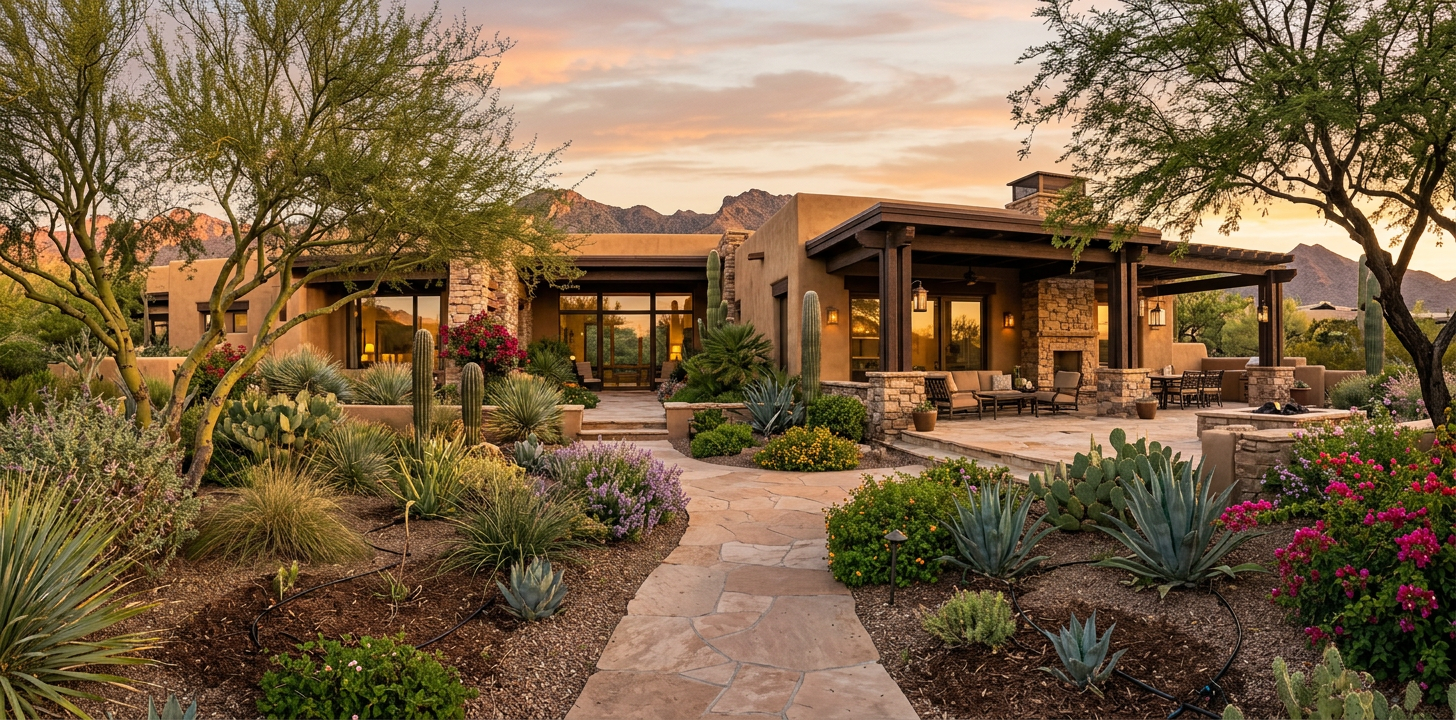
Irrigation Design Water Saving for Arizona Luxury Home Landscapes
A water-efficient landscape should never feel like a compromise. For custom homes and major renovations in Scottsdale, Paradise Valley, Tempe, and the East Valley, the most successful outdoor environments combine thoughtful planting, shade, architecture, drainage, and irrigation design water saving into one coordinated plan.
We see the same issue repeatedly: irrigation is treated as a final installation detail after hardscape, pools, lighting, and planting decisions have already been made. That approach can lead to exposed pipe routes, water on paving, stressed trees, mismatched valve zones, and expensive corrections. Water-saving irrigation works best when it is designed early, alongside the entire landscape.
Water Savings Begin With a Landscape Plan, Not a Controller
Smart controls can help, but they cannot correct a system that applies water to the wrong plants, too quickly for the soil, or too close to a home’s foundation. Effective irrigation planning begins by understanding how the property will function and how each area will mature over time.
The U.S. Environmental Protection Agency reports that outdoor water use can account for as much as 60 percent of household water use in arid regions. It also notes that inefficient irrigation methods and systems can lose substantial water to wind, evaporation, and runoff. EPA WaterSense estimates that replacing a clock-based controller with a WaterSense labeled irrigation controller can reduce an average home’s irrigation water use by up to 30 percent.
For Arizona properties, water efficiency is not simply about running irrigation less often. It is about applying the appropriate amount of water, at an appropriate rate, to the correct root zone.
| Design Decision | Water-Saving Benefit | Long-Term Landscape Value |
|---|---|---|
| Hydrozones by plant need | Prevents overwatering | Healthier planting |
| Soil-aware runtimes | Reduces runoff | Better root development |
| Separate tree zones | Supports deep roots | Protects mature canopy |
| Weather-responsive controls | Adjusts seasonal watering | Less manual guesswork |
| Early sleeve coordination | Avoids future hardscape cuts | Cleaner construction |
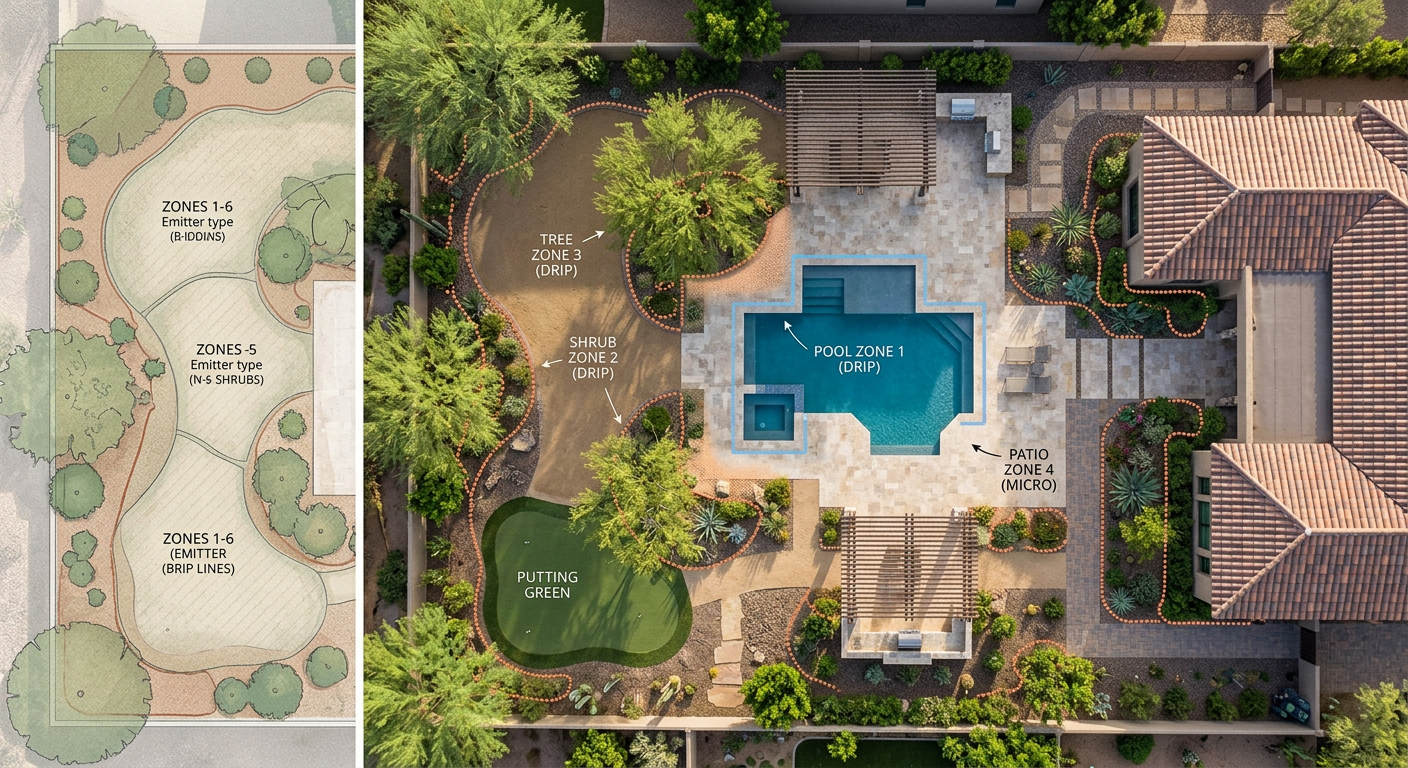
Hydrozones Are the Foundation of Water-Efficient Irrigation
Hydrozones group plants with similar water needs, sun exposure, root depth, and irrigation methods on the same valve. This is the central principle behind irrigation design water saving because it prevents a single high-water-use area from determining the schedule for an entire property.
A luxury residential landscape may have several distinct water needs, including established shade trees, desert-adapted shrubs, ornamental entry planting, containers, turf used for a defined activity area, and poolside planting exposed to reflected heat. These areas should not be watered on the same schedule simply because they are near one another.
We typically evaluate each planting area according to:
- Plant type and expected mature size
- Sun, shade, reflected heat, and wind exposure
- Soil texture, compaction, and infiltration rate
- Slope and drainage patterns
- Proximity to foundations, walls, paving, and pools
- Visibility and maintenance expectations
- The future expansion of tree root zones
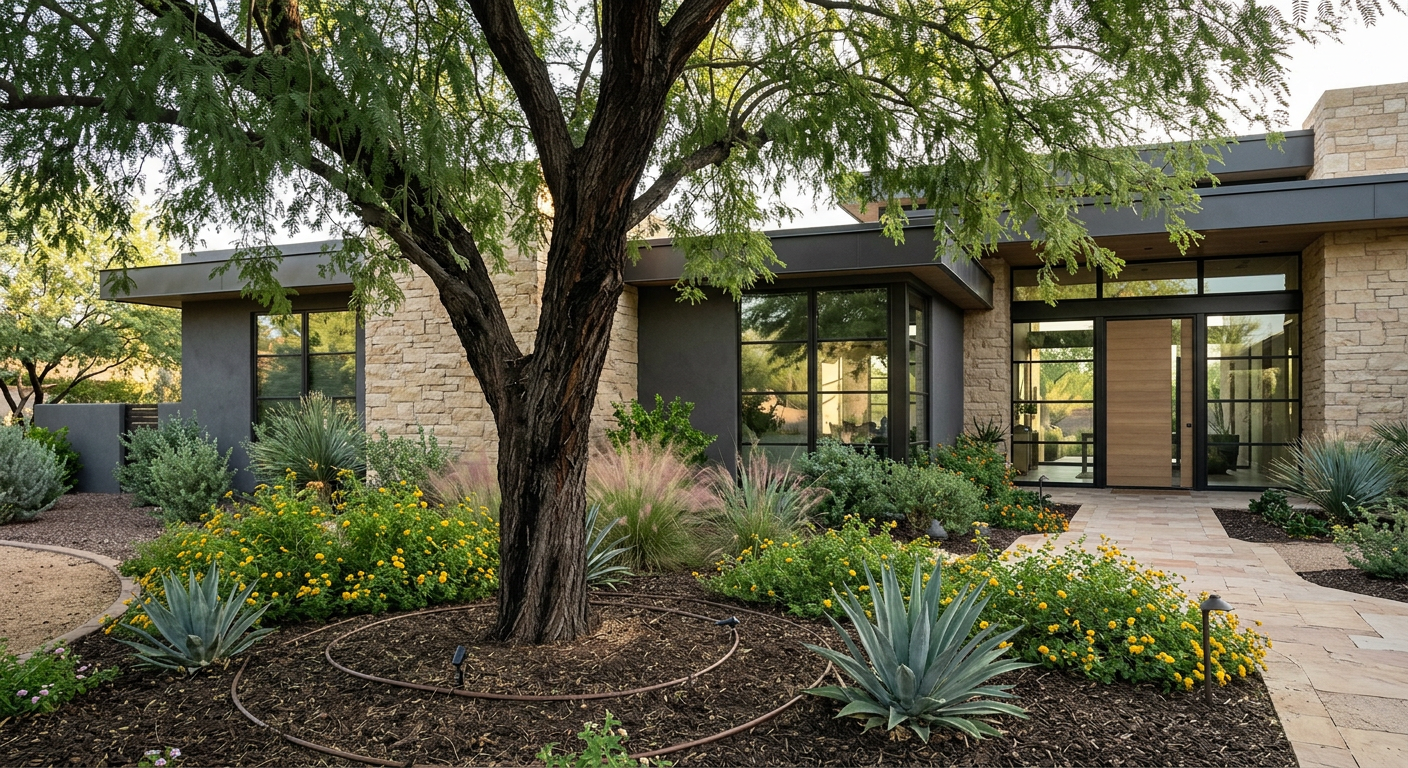
A small tree at installation may need water delivered near its original root ball. A mature specimen tree needs moisture distributed farther from the trunk, across a much broader active root area. Designing for that change avoids the common mistake of leaving emitters in the same location for years.
Choose Irrigation Equipment for the Planting and Site Conditions
No single irrigation method suits every part of a high-end Arizona landscape. The right equipment depends on the plant palette, soil, grade, architectural features, and intended use of the outdoor space.
Drip Irrigation for Planting Beds and Architectural Edges
Drip irrigation is often well suited to shrubs, perennials, specimen plants, and narrow planting areas near walls or paving. It can place water close to the root zone while reducing overspray on windows, hardscape, and outdoor furnishings.
However, a quality drip system requires more than tubing. Proper filtration, pressure regulation, accessible valves, flush points, and adjustable emitter locations all influence performance. A poorly planned drip layout can still create dry areas, saturated areas, root problems, and wasted water.
Bubblers and Basins for Larger Trees
Bubblers or basin-style systems can support larger trees when they are designed to wet a broad root zone at a rate the soil can absorb. They are especially useful where mature trees are a major part of the property’s shade, scale, and character.
On sloped sites in North Scottsdale, Carefree, or Cave Creek, cycle-and-soak scheduling may be needed. This approach divides a longer watering event into shorter cycles so water can infiltrate rather than flow downhill toward paving or drainage structures.
Spray Irrigation for Purposeful Turf Areas
Turf can have a place in a custom landscape when it supports recreation, pets, or a particular design goal. It should be limited to intentional areas and separated from drip-irrigated planting zones.
Spray irrigation requires matched precipitation rates, suitable pressure, head-to-head coverage, and careful placement. Water should land on the turf area, not on driveways, walls, pathways, or pool decking.
Soil, Grade, and Construction Details Affect Every Drop
Water-saving irrigation is inseparable from soil conditions and site grading. Compacted soil, caliche layers, construction disturbance, steep slopes, and poor finish grades can all cause irrigation water to run off before plants can use it.
That is why irrigation should be coordinated with drainage, retaining walls, paving, pool decks, landscape lighting, and utilities during plan development. Early coordination allows us to place sleeves beneath hardscape, identify practical valve locations, preserve root zones, and avoid disruptive changes after construction has begun.
For a major remodel, this work is particularly important. New patios and outdoor kitchens often alter drainage and access. Existing trees may need protection. Aging irrigation lines may no longer serve the revised landscape. A comprehensive plan helps the project team understand where water will go, where it should not go, and how the system can remain serviceable after installation.
A Progressive Water-Saving Strategy for Aging Landscapes
The best irrigation improvements do not always require replacing everything at once. For established homes, we often recommend a phased approach that addresses the highest-impact performance issues first while keeping the future landscape plan in view.
Phase One: Audit the Existing System
Start by identifying valve zones, pipe condition, controller capability, pressure concerns, leaks, overspray, and plant areas that are receiving incompatible schedules. A landscape can look healthy while quietly wasting water or placing mature trees under unnecessary stress.
Phase Two: Correct the Layout Before Adding Technology
A new controller is valuable only after the zones make sense. We recommend separating trees, ornamental planting, containers, turf, and desert-adapted areas where practical. This creates the control needed for seasonal adjustments.
Phase Three: Upgrade Controls and Fine-Tune Scheduling
Weather-responsive controllers and rain or soil-moisture inputs can help reduce overwatering when they are configured for the site. Seasonal adjustments should account for plant maturity, weather, exposure, and actual system output rather than relying on one fixed annual schedule.
Phase Four: Plan for Future Renovations
When a property is likely to receive new hardscape, a pool renovation, or expanded outdoor living areas, we document the irrigation intent so future work can protect pipe routes, sleeves, valves, and tree root zones. This is where professional construction documents can help preserve long-term value.
Planning a Water-Efficient Landscape Project?
If you are building or remodeling in Tempe, Scottsdale, Paradise Valley, Phoenix, or the surrounding area, early irrigation planning can help protect mature trees, improve landscape performance, and reduce unnecessary water use. Our residential landscape architecture approach coordinates planting, hardscape, outdoor living, irrigation, and long-term maintenance considerations into one cohesive design.
Call (480) 893-3849 to discuss your project with Waibel & Associates, or request a landscape architecture consultation →
Professional Irrigation Design Supports Architecture and Property Value
A refined landscape should complement the home instead of competing with it. The irrigation system should be equally intentional, even though much of it remains out of sight.
At Waibel & Associates, we consider irrigation as part of a complete landscape architecture process. That includes site analysis, plant selection, tree preservation, soil improvement, hardscape planning, drainage coordination, construction documentation, and construction administration. Our landscape architecture services are structured to help owners, architects, builders, and property managers carry the original design intent through installation.
Janet Waibel, RLA, Owner and Principal of Waibel & Associates Landscape Architecture, brings experience in planning, landscape construction, irrigation, and sustainable landscape management. Her published resources are also useful for owners and professionals who want a deeper understanding of durable landscape practices. Explore Landscape Architecture Books by Janet Waibel.
Frequently Asked Questions
How does irrigation design save water in Arizona?
Irrigation design saves water by matching water delivery, schedules, and equipment to specific plant zones and site conditions. Separating trees, shrubs, turf, containers, and ornamental beds prevents one area’s needs from causing overwatering elsewhere.
Is drip irrigation always the best choice for a luxury landscape?
No. Drip irrigation is excellent for many planting beds, but mature trees, turf areas, and certain site conditions may require different approaches. The best solution depends on root-zone size, soil, grade, plant selection, and the desired outdoor experience.
Can an existing irrigation system be improved without a full landscape renovation?
Yes. An irrigation audit can identify leaks, poor hydrozoning, pressure issues, overspray, and outdated controls. Improvements can often be phased so they support future landscape upgrades instead of becoming temporary fixes.
Do smart irrigation controllers eliminate the need for inspections?
No. Smart controllers can improve scheduling, but they cannot detect every clogged emitter, broken line, displaced head, or damaged valve. Periodic field inspections remain necessary to keep the system working as intended.
Why should mature trees have their own irrigation zones?
Mature trees have broad, deep root systems and different watering needs than ornamental planting or turf. A dedicated zone helps deliver water across the active root area without forcing trees onto a frequent schedule intended for smaller plants.
What should homeowners ask before installing irrigation near a pool or patio?
Ask how irrigation routes, drainage, sleeves, lighting conduits, and planting areas will be coordinated before hardscape installation. This planning reduces future demolition, helps prevent water on paving, and keeps maintenance access more practical.
Better Water Management Creates a More Enduring Landscape
A beautiful Arizona landscape can be water-conscious, richly planted, and architecturally refined at the same time. The difference comes from planning irrigation as an integrated design system rather than an afterthought.
When hydrozones, soil conditions, tree needs, hardscape, drainage, and seasonal scheduling work together, the landscape is better prepared to mature gracefully. It also becomes easier to manage, more resilient through changing conditions, and more aligned with the investment you have made in the property.
Talk With an Experienced Arizona Landscape Architect
For a custom home, major renovation, outdoor living environment, irrigation upgrade, or sustainable landscape renovation, we can help create a design that supports your property’s architecture and long-term goals. Learn more about Janet Waibel and Waibel & Associates, then contact us to begin the conversation.
Call (480) 893-3849
Contact Waibel & Associates →
About Waibel & Associates Landscape Architecture
Waibel & Associates Landscape Architecture is an Arizona landscape architecture firm led by Janet Waibel, RLA, Owner and Principal. The firm provides custom residential landscape architecture, sustainable landscape design, irrigation planning, tree preservation, outdoor living design, site planning, construction documentation, and professional landscape consulting throughout Tempe, Scottsdale, Paradise Valley, Phoenix, North Scottsdale, Carefree, Cave Creek, and surrounding Arizona communities.
Waibel & Associates focuses on thoughtful, high-quality landscapes that complement the architecture of each property while incorporating appropriate plant materials, water-efficient strategies, irrigation technology, and long-term planning.
Janet Waibel is also a published author whose books provide educational resources on sustainable landscape management and landscape construction.
Planning a custom residential or professional landscape project?
Call (480) 893-3849
or
Contact Waibel & Associates →
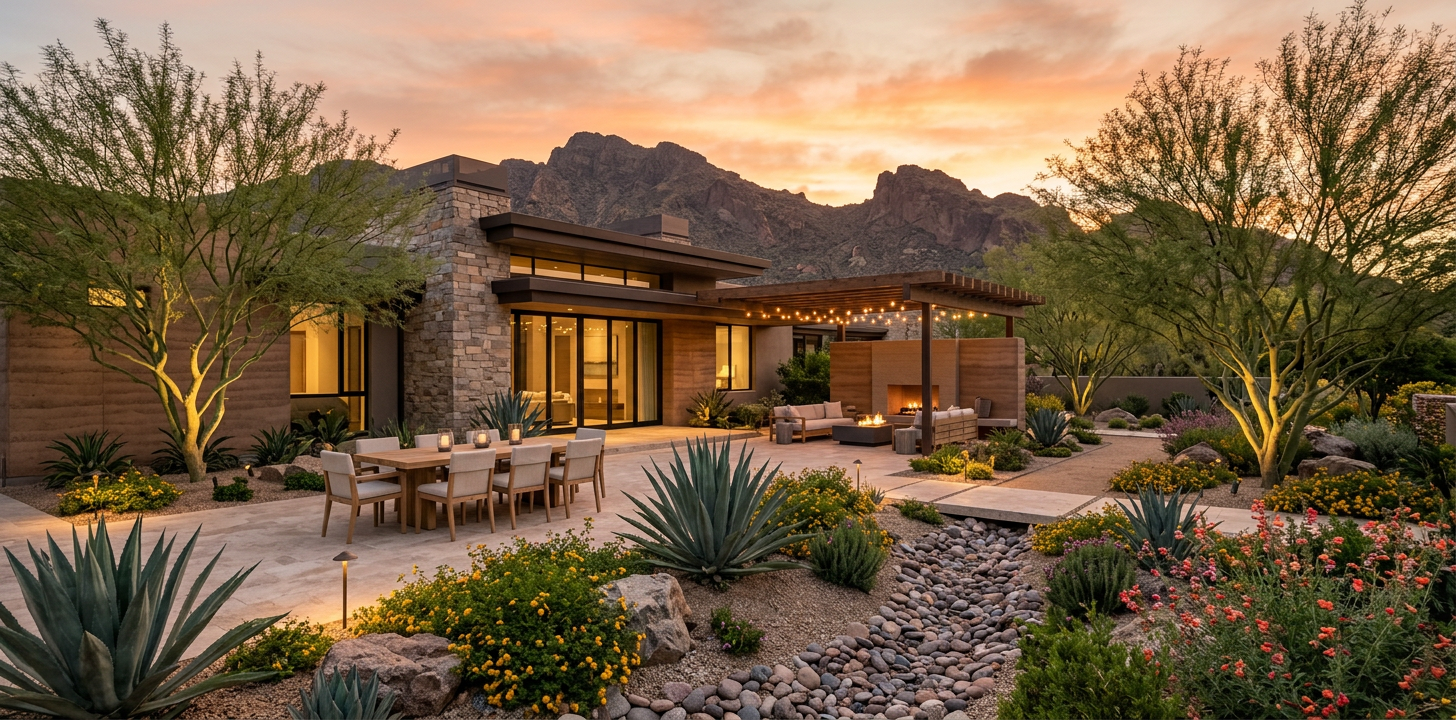
Water Efficient Landscape Design Phoenix for Luxury Outdoor Living
A beautiful Phoenix property does not need to rely on thirsty planting or oversized turf to feel welcoming, lush, and complete. The most successful outdoor environments respond to the home’s architecture, the site’s exposure, how the family lives outdoors, and the realities of the Sonoran Desert.
Water efficient landscape design Phoenix homeowners can rely on begins with professional planning, not a last-minute plant palette. It combines appropriate shade, carefully selected plant communities, irrigation zoning, drainage planning, durable materials, and outdoor living spaces that feel generous without creating unnecessary water demand.
For custom homes, major remodels, communities, and estate properties, we see water efficiency as a design discipline. It is not a stripped-down look. Done well, it creates a more comfortable, more resilient landscape with a clear sense of place.
Why Outdoor Water Planning Matters in Phoenix
The Arizona Department of Water Resources reports that landscaping is the state’s largest use of potable water and that outdoor use can represent as much as 70 percent of residential water use. That makes the landscape plan one of the most meaningful places to improve efficiency without giving up beauty or function. Arizona Department of Water Resources
The City of Phoenix similarly notes that desert-friendly plants can provide varied form, color, and texture while requiring less water and care when they are suited to local soils and weather. City of Phoenix Outdoor Conservation Resources
For high-end residential properties, the goal is not simply to use fewer plants. It is to use plants and materials with intention, so shade, privacy, arrival sequences, views, entertaining areas, and architectural character work together.
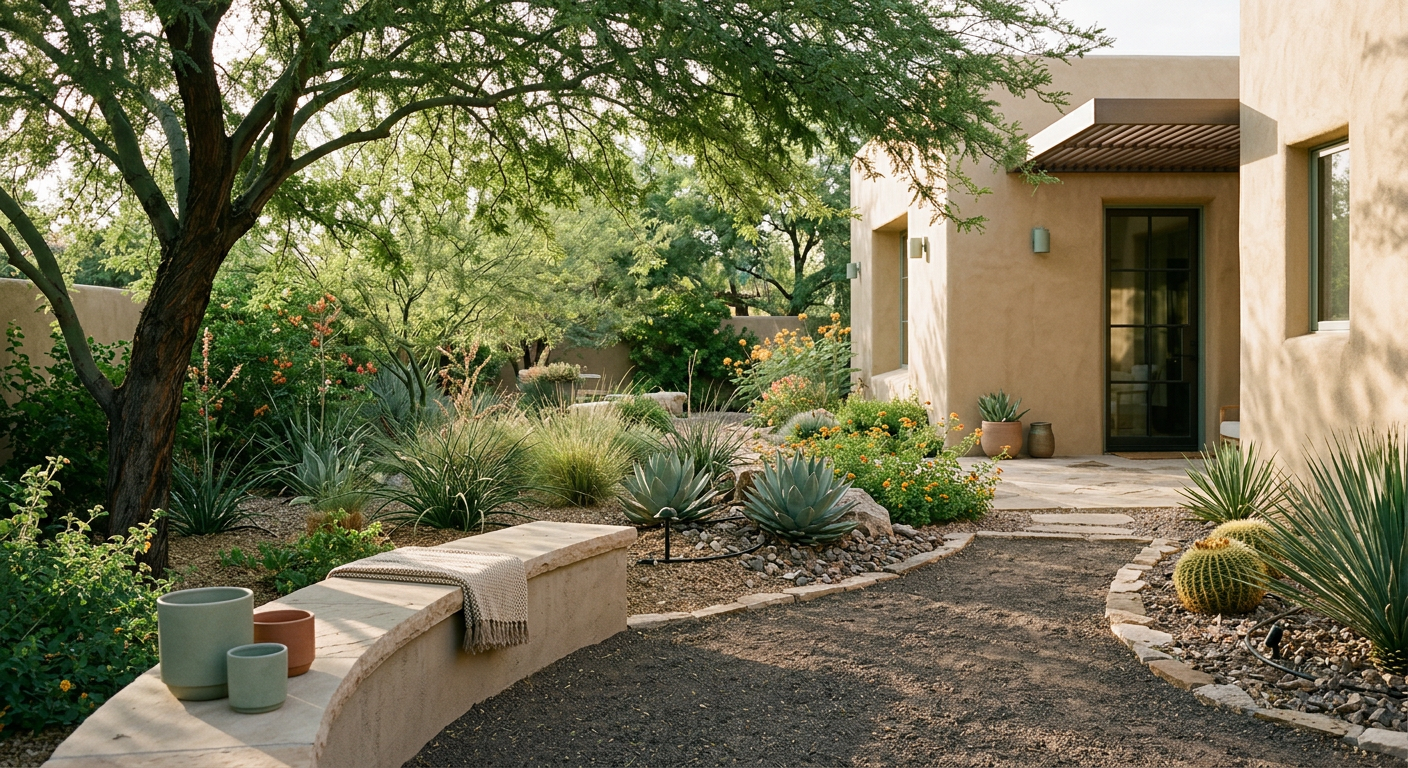
How Water Efficient Landscape Design Phoenix Projects Create Value
A lower-water landscape should be planned as a complete site system. When isolated choices are made without a larger plan, homeowners can end up with poor shade coverage, plants competing for water, drainage problems, or irrigation that is difficult to manage.
Start With Site Analysis and Architectural Integration
We begin by studying sun exposure, existing grades, drainage patterns, views, mature trees, utility constraints, and the circulation between indoor and outdoor rooms. This process identifies where shade is most valuable, where planting can support privacy, and which spaces need durable hardscape for daily use.
This is especially important for custom homes and remodels in Phoenix, Scottsdale, Paradise Valley, and Tempe, where the landscape should reinforce the architectural language rather than compete with it. Explore our approach to custom residential landscape architecture for homes that need coordinated planting, paving, lighting, and outdoor amenities.
Design Plant Communities, Not a Collection of Individual Plants
A strong desert planting design uses trees, shrubs, accents, groundcovers, and seasonal color in purposeful layers. Plants with compatible water needs should be grouped together, while high-water-use areas are limited to places where they serve a specific lifestyle or visual purpose.
Desert-adapted does not have to mean sparse. Canopy trees can cool patios and windows, flowering shrubs can frame views, and sculptural succulents can provide strong form near entries, pools, or contemporary architecture. The key is selecting materials that mature well in the available space and support the intended irrigation strategy.
Make Irrigation Part of the Design, Not an Afterthought
Irrigation is where a thoughtful plan becomes practical. Hydrozone planning separates plant areas with different water needs, allowing trees, shrubs, accent plants, and any turf to receive appropriate schedules rather than one blanket approach.
Drip irrigation, properly located emitters, pressure regulation, seasonal controller adjustments, and accessible valves all matter. The City of Phoenix recommends watering from sundown to sunrise to reduce evaporation and adjusting irrigation frequency with the weather. Phoenix Water Conservation Guidance
At Waibel & Associates, our landscape architecture services include planting and irrigation design, site planning, cost estimating, and construction administration. Those connected decisions help protect the visual quality of the project as it moves from design into installation.
Use Shade and Hardscape Strategically
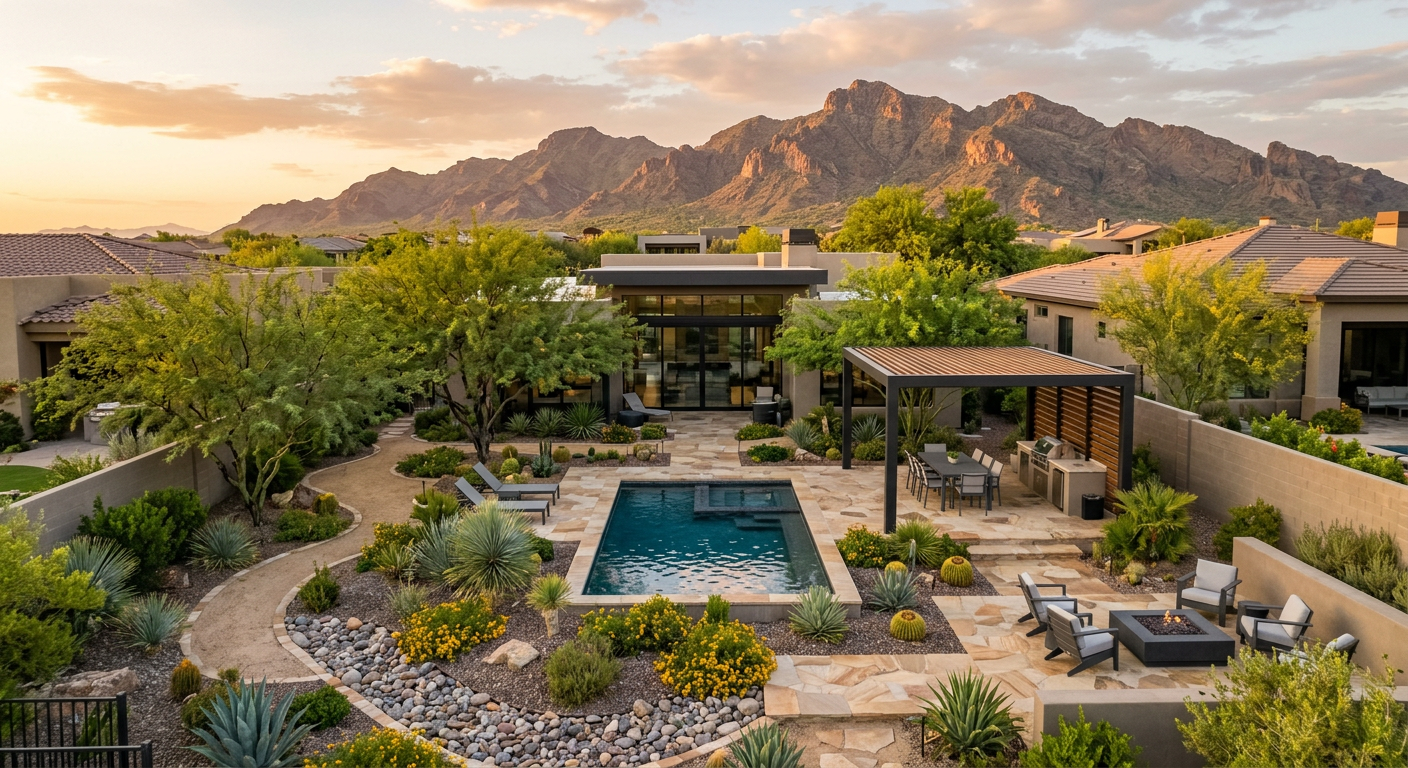
Hardscape is not automatically water efficient. Large expanses of paving can intensify heat, increase glare, and make an outdoor space less inviting during much of the year. A better approach balances patios, pool decks, paths, permeable areas, shade structures, canopy trees, and planting beds.
We often plan shade first around the outdoor spaces that matter most: kitchen-adjacent patios, lounge areas, pool seating, guest entries, and view-oriented gathering spaces. That creates more usable outdoor living while allowing the planting design to do real environmental work.
Water-Wise Design Choices for Luxury Properties
The right choices depend on the property, architecture, and client priorities, but several principles consistently improve water performance.
- Preserve mature trees when feasible. Existing canopy can provide years of shade value that new planting cannot immediately replace.
- Limit high-water zones. If a green play area or formal lawn is important, keep it purposeful, compact, and separately irrigated.
- Plan for rain where it falls. Grade planting areas and use subtle swales, basins, and drainage routes to direct rainwater into the landscape rather than away from it.
- Improve soil where planting requires it. Appropriate soil preparation supports healthier root systems and reduces the tendency to overwater.
- Specify mulch and finish materials carefully. Materials should support the style of the home while moderating evaporation, protecting soil, and allowing maintenance access.
- Plan for maintenance access. A beautiful landscape needs practical room for pruning, controller adjustments, and long-term care.
According to the Arizona Department of Water Resources’ Phoenix-area outdoor water use study, homes with arid and sparse landscape categories used substantially less water than homes in turf or extensive landscape categories. Phoenix Metropolitan Area Outdoor Water Use Study
Planning a Custom Landscape Project?
If you are building or remodeling a home in Phoenix, Tempe, Scottsdale, Paradise Valley, or the surrounding area, early landscape planning can help protect your investment and create a cohesive outdoor environment from the beginning. We coordinate site planning, outdoor living, planting, irrigation, hardscape, and construction details around the way you want to use the property.
Call (480) 893-3849 to discuss your project with Waibel & Associates, or request a landscape architecture consultation.
Avoid These Common Water-Efficiency Mistakes
A landscape can include attractive low-water plants and still use more water than necessary. The most common reason is a mismatch between the design, irrigation system, and maintenance expectations.
Treating Every Plant Zone the Same
When every area is placed on one irrigation schedule, trees, shrubs, flowering accents, and groundcovers are forced into the same watering pattern. That often leads to overwatering some areas and stressing others. Zoning should reflect plant type, exposure, soil, and root depth.
Replacing Turf With Gravel Alone
Removing a water-demanding lawn can be appropriate, but an all-gravel result may create glare, stored heat, and little ecological or visual benefit. Layered, regionally appropriate planting can bring shade, texture, habitat, and seasonal interest while remaining water conscious.
Designing Without a Construction Plan
Concept imagery can inspire a project, but it does not resolve grades, drainage, plant quantities, irrigation components, material transitions, or installation details. Construction documents reduce ambiguity and give contractors a clearer path to build the intended design.
Janet Waibel, RLA, Owner and Principal of Waibel & Associates Landscape Architecture, brings experience in landscape planning, irrigation, construction, and sustainable design to these decisions. Homeowners and property professionals can also explore landscape architecture books by Janet Waibel for deeper guidance on sustainable landscape management and construction principles.
Questions Phoenix Property Owners Ask
Can a water-efficient landscape still look luxurious?
Yes. Luxury comes from composition, craftsmanship, material quality, shade, proportion, lighting, and a landscape that complements the home. Water-efficient planting can be richly layered and visually refined when it is professionally designed.
When should landscape architecture begin for a custom home?
Landscape planning should begin during architectural design or early site planning. Early coordination helps reserve room for outdoor living, drainage, utilities, tree preservation, views, and appropriate finished grades.
Is drip irrigation always the best choice in Phoenix?
Drip irrigation is often appropriate for trees, shrubs, accents, and many planting beds. The right system depends on plant material, soil conditions, exposure, and the requirements of each zone.
Should we remove all turf from a Phoenix property?
Not necessarily. A limited, purposeful lawn may suit a family’s lifestyle or a specific outdoor space. The important consideration is whether the turf area earns its water use and is separately designed and irrigated for efficient performance.
Can mature trees be protected during a remodel?
Often, yes. Tree preservation should be evaluated early so construction access, grading, utility routes, and root protection measures can be planned before work begins.
Does Waibel & Associates work with architects and custom builders?
Yes. We work with homeowners and project teams on site planning, planting and irrigation design, hardscape planning, construction documentation, and coordination during installation.
A More Resilient Landscape Starts With Better Planning
Water efficiency is most successful when it is built into the design from the beginning. A well-planned Phoenix landscape can create meaningful shade, memorable outdoor rooms, healthy plant growth, and a stronger relationship between the home and its desert setting.
Rather than treating conservation as a limitation, we can use it as a framework for better decisions. The result is an outdoor environment designed to remain beautiful, functional, and manageable through changing seasons.
Talk With an Experienced Arizona Landscape Architect
Whether you are planning a custom home, major residential remodel, outdoor living environment, irrigation upgrade, or sustainable landscape renovation, Waibel & Associates can help create a thoughtful design that complements your property and long-range goals.
Call (480) 893-3849 or contact Waibel & Associates to discuss your project.
About Waibel & Associates Landscape Architecture
Waibel & Associates Landscape Architecture is an Arizona landscape architecture firm led by Janet Waibel, RLA, Owner and Principal. The firm provides custom residential landscape architecture, sustainable landscape design, irrigation planning, tree preservation, outdoor living design, site planning, construction documentation, and professional landscape consulting throughout Tempe, Scottsdale, Paradise Valley, Phoenix, North Scottsdale, Carefree, Cave Creek, and surrounding Arizona communities.
Waibel & Associates focuses on thoughtful, high-quality landscapes that complement the architecture of each property while incorporating appropriate plant materials, water-efficient strategies, irrigation technology, and long-term planning.
Janet Waibel is also a published author whose books provide educational resources on sustainable landscape management and landscape construction.
Planning a custom residential or professional landscape project?
Call (480) 893-3849
or
Contact Waibel & Associates →