 Demo Demo
Sustainable Landscape Design Principles From Janet Waibel
A lasting Arizona landscape begins with more than attractive plants or a new patio. It begins with a clear understanding of the site, the architecture, the way people will use the property, and the resources required to keep the landscape healthy over time.
The sustainable landscape design principles Janet Waibel applies are grounded in that larger view. For custom homes, major remodels, and aging properties throughout Tempe, Scottsdale, Paradise Valley, Phoenix, and the East Valley, we see sustainability as the discipline of creating outdoor environments that are beautiful, functional, water-conscious, and built to mature well.
Janet Waibel, RLA, Owner and Principal of Waibel & Associates Landscape Architecture, has developed an approach that brings site planning, irrigation, plant selection, construction details, and long-term management into one coordinated design process. The goal is not a landscape that merely survives the desert. The goal is a landscape that feels integral to the property and remains worthy of the investment.
Sustainability Starts With the Whole Property
Sustainable design works best when the house, site, outdoor rooms, grading, planting, and irrigation are planned as one connected system. Treating those elements as separate decisions often produces avoidable compromises, such as trees placed too close to paving, planting areas that are difficult to irrigate efficiently, or outdoor living spaces that lack shade when it matters most.
For a luxury residence, sustainability should support comfort and architectural character. A formal entry, a pool environment, a private courtyard, and a view-facing terrace may each need different plant palettes, materials, and irrigation zones. The common thread is intentionality. Every landscape element should have a purpose related to beauty, performance, or the long-term use of the property.
This is why early site planning matters. Our approach considers sun exposure, topography, drainage patterns, existing vegetation, views, privacy, access, and the home’s architectural language before the planting plan is finalized. Explore our perspective on site planning in landscape architecture to see why a coordinated plan protects both the design and the construction budget.
Design for Water Efficiency Without Designing for Scarcity
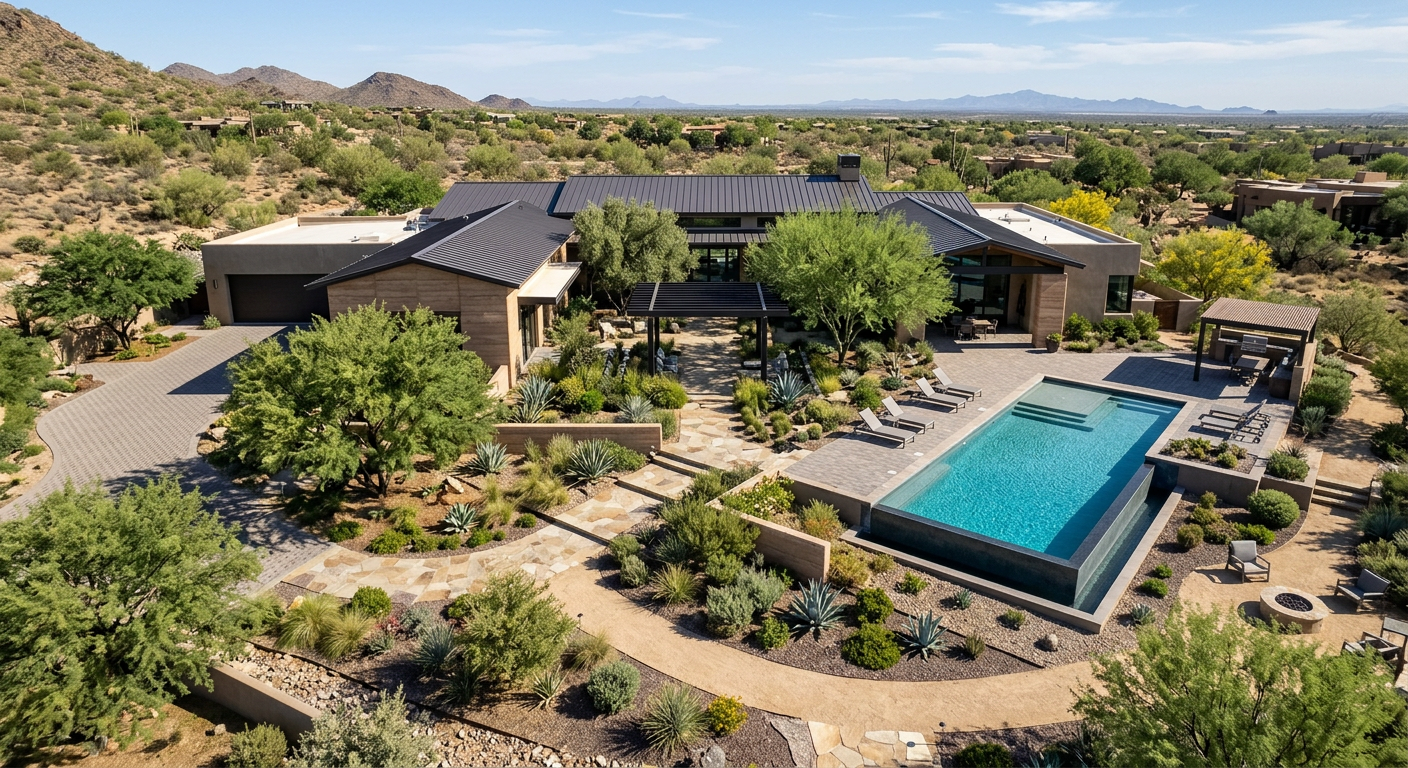
Water-efficient landscape planning is central to sustainable landscape design in Arizona, but a low-water landscape should never look underdesigned. The strongest properties use water where it delivers value, then organize plants and irrigation so that water is applied appropriately rather than indiscriminately.
The Arizona Department of Water Resources reports that as much as 70 percent of residential water use can occur outdoors. It also identifies regionally appropriate design, plant selection, and irrigation practices as important ways to reduce landscape water use. Arizona Department of Water Resources
For a high-end residential landscape, that principle often includes:
- Grouping plants with compatible water needs into appropriate hydrozones
- Using trees strategically for shade, scale, privacy, and microclimate benefits
- Limiting high-water planting to locations where it has a clear visual or functional purpose
- Specifying irrigation equipment that matches the plant material and site conditions
- Designing paving, slopes, and drainage to reduce runoff and protect planted areas
- Allowing adequate space for plants to reach their intended mature form
A lush result is still possible. The difference is that the landscape is composed around climate, exposure, soil conditions, and real plant requirements rather than relying on excess water to correct poor planning.
Irrigation Is a Design Decision, Not a Final Add-On
Irrigation is one of the most consequential parts of a sustainable landscape, particularly in the desert Southwest. A thoughtful irrigation design accounts for plant water needs, pressure, hydrozones, controller programming, distribution uniformity, access for maintenance, and future adjustments as plants mature.
When irrigation is postponed until the end of a project, the system may be forced into planting and hardscape decisions that have already limited its performance. We recommend coordinating irrigation during the design phase so it supports the overall composition from the beginning. Our article on desert landscape irrigation design explains why an irrigation plan should be connected to the property’s architecture, planting design, and long-term maintenance expectations.
Preserve What Already Adds Value
Mature trees, established grades, and healthy landscape features can be valuable assets when they are evaluated before construction begins. Preservation is sustainable because it can retain shade, scale, habitat, and a sense of maturity that a newly installed landscape may take years to recreate.
That does not mean every existing element should remain. Some trees may be poorly located, declining, incompatible with the new architecture, or affected by necessary construction. The important principle is evaluation before demolition. A professional assessment helps the project team decide what deserves protection, what can be relocated, and what should be replaced with a better long-term solution.
Tree preservation also requires coordination. Root zones, access routes, grading changes, utilities, wall locations, and drainage all affect a tree’s future. Protecting a trunk while disturbing the roots or changing soil levels around it is rarely enough. Sustainable planning addresses the entire growing environment.
Choose Plants for Mature Form, Not Just Immediate Color
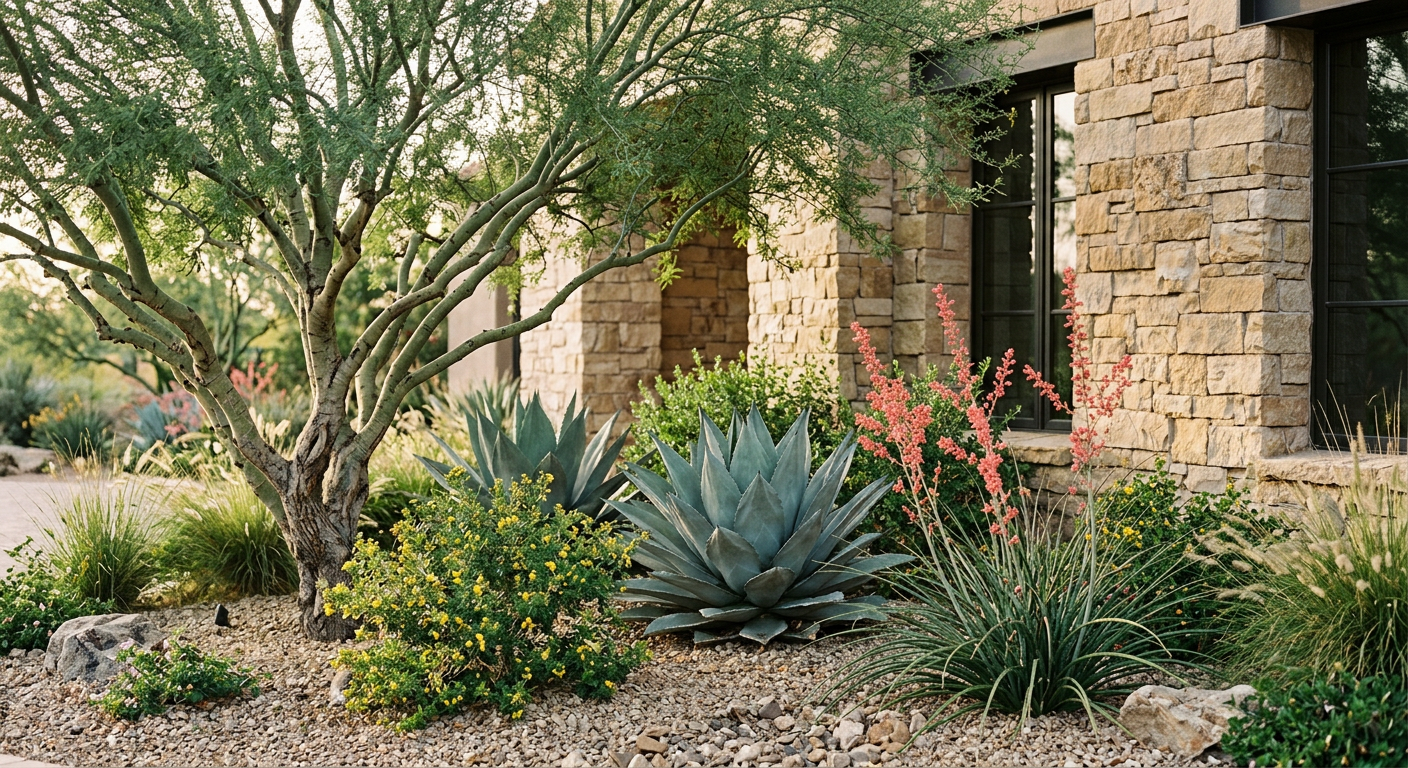
Sustainable plant selection is a composition and maintenance decision as much as a water decision. Plants should be selected for their form, texture, scale, seasonal interest, shade potential, screening value, and relationship to the home, not simply because they are widely available.
A landscape that looks finished on installation day can become crowded and expensive if plants were spaced for a short-term photograph rather than their mature size. By giving trees, shrubs, accents, and groundcovers room to develop, the design can become more refined over time with less unnecessary pruning, replacement, and irrigation demand.
Janet Waibel’s published work emphasizes the connection between design intent and responsible long-term care. Her book Sustainable Landscape Management: A Guide to Care in the Desert Southwest is a useful resource for homeowners, property managers, and landscape professionals who want to better understand installation quality, irrigation efficiency, and landscape stewardship. Explore Landscape Architecture Books by Janet Waibel.
Build Durable Outdoor Living Spaces
Sustainable outdoor living design favors durable materials, properly detailed construction, and spaces that people will genuinely use. A beautiful terrace that overheats, drains poorly, or lacks comfortable shade will not perform as intended, regardless of its materials.
For homes in Scottsdale, Paradise Valley, Carefree, and similar desert settings, the design team should consider solar exposure, reflected heat, wind, views, privacy, furnishings, circulation, and the relationship between indoor and outdoor rooms. Shade structures, trees, walls, paving materials, and planting all contribute to comfort.
Construction documents matter because they communicate the design intent to the contractor. Clear details for walls, paving, drainage, irrigation, lighting coordination, and planting help reduce ambiguity during installation. This is one reason professional landscape architecture services are valuable for complex residential projects. Good design must also be buildable, maintainable, and consistent with the owner’s goals.
Plan for Stewardship After Construction
A sustainable landscape is not complete when installation ends. It needs informed care, seasonal observation, irrigation adjustments, soil attention, and selective renewal as the property evolves.
This is especially relevant for luxury properties with layered planting, specimen trees, pools, outdoor kitchens, and extensive hardscape. Maintenance should preserve the design instead of gradually simplifying it into a collection of over-sheared shrubs and mismatched replacements. A clear management plan gives owners and property managers a stronger basis for protecting the original investment.
The sustainable landscape design principles Janet Waibel teaches recognize that durability is not accidental. It is created through informed decisions before construction and responsible stewardship after the project is complete.
Plan Your Arizona Landscape With Long-Term Performance in Mind
If you are building a custom home, remodeling a significant property, or rethinking an aging landscape, early professional planning can help align beauty, water efficiency, outdoor living, and construction quality. We work with homeowners, architects, builders, developers, HOAs, and property managers to create landscape solutions that support the architecture and the way each property will be used.
Explore Waibel & Associates Landscape Architecture or request a landscape architecture consultation. You can also call (480) 893-3849 to discuss your project.
Frequently Asked Questions
What makes a landscape design sustainable in Arizona?
A sustainable Arizona landscape is designed around the site, climate, appropriate plant materials, efficient irrigation, durable construction, and realistic long-term care. It should use resources thoughtfully while still providing shade, beauty, comfort, and value for the property.
Can a water-efficient landscape still look lush and luxurious?
Yes. Water efficiency does not require a barren or overly simplified landscape. A layered planting composition, strategic shade trees, carefully placed accents, and well-designed outdoor rooms can create a rich setting while using water more intentionally.
Should irrigation be designed before landscape construction begins?
Yes. Irrigation should be coordinated during design, before hardscape and planting are installed. Early planning allows the system to be organized around hydrozones, plant needs, site pressure, access, and the layout of outdoor spaces.
Is tree preservation worthwhile during a major home remodel?
It can be, particularly when mature trees provide meaningful shade, scale, screening, or character. A landscape architect can help evaluate the tree’s condition, location, root protection needs, and compatibility with the proposed construction work.
How does a landscape architect help during construction?
A landscape architect develops plans and details that clarify design intent, materials, planting, irrigation, grading, and site elements. Construction administration can also help the owner and project team address field conditions while protecting the quality and cohesion of the design.
What should homeowners ask before hiring a landscape architect?
Homeowners should ask about experience with projects of similar scope, the design process, coordination with architects and builders, irrigation and water-efficiency expertise, construction documentation, and how the firm approaches long-term performance. It is also useful to discuss priorities such as privacy, shade, entertaining, views, tree preservation, and phased construction.
A Better Landscape Is Planned to Endure
Sustainability becomes meaningful when it improves the way a property looks, feels, performs, and matures. The most successful Arizona landscapes respect the climate while creating comfortable outdoor spaces, protecting valuable site resources, and complementing the architecture with a clear sense of purpose.
By coordinating site planning, irrigation, planting, hardscape, and construction details from the start, owners can make decisions that hold their value long after the first installation is complete.
Talk With an Experienced Arizona Landscape Architect
For a custom home, major residential remodel, outdoor living environment, irrigation upgrade, or sustainable landscape renovation, Waibel & Associates can help create a thoughtful design that complements your property and long-term goals.
Call (480) 893-3849 or Contact Waibel & Associates to begin a conversation about your project.
About Waibel & Associates Landscape Architecture
Waibel & Associates Landscape Architecture is an Arizona landscape architecture firm led by Janet Waibel, RLA, Owner and Principal. The firm provides custom residential landscape architecture, sustainable landscape design, irrigation planning, tree preservation, outdoor living design, site planning, construction documentation, and professional landscape consulting throughout Tempe, Scottsdale, Paradise Valley, Phoenix, North Scottsdale, Carefree, Cave Creek, and surrounding Arizona communities.
Waibel & Associates focuses on thoughtful, high-quality landscapes that complement the architecture of each property while incorporating appropriate plant materials, water-efficient strategies, irrigation technology, and long-term planning.
Janet Waibel is also a published author whose books provide educational resources on sustainable landscape management and landscape construction.
Planning a custom residential or professional landscape project?
Call (480) 893-3849
or
Contact Waibel & Associates →

Demo Demo
Nemo enim ipsam voluptatem quia voluptas sit aspernatur odit fugitquia consequuntur magni dolores eos qui ratione voluptatem sequi nesciun tosomo. Nemo enim ipsam voluptatem quia voluptas sit aspernatur.